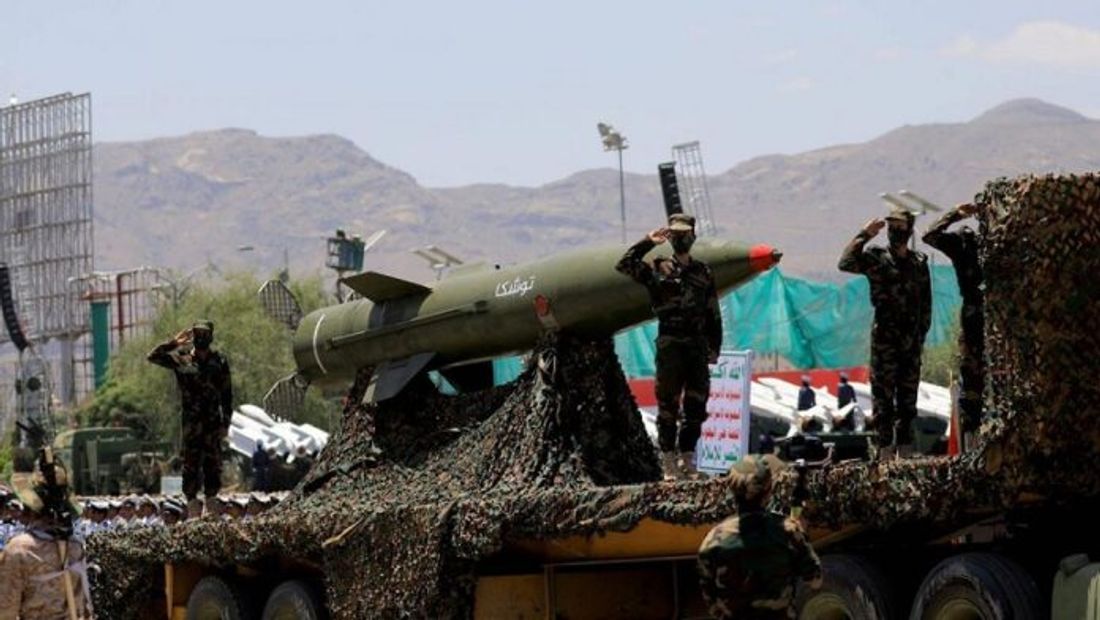
The American newspaper The Wall Street Journal published a report by Lawrence Norman and Benoit Faucon, stating that Yemen’s Houthis are attempting to build advanced ballistic missiles using Chinese components.
A new report by Conflict Armament Research revealed that the Houthis are seeking to produce advanced ballistic missiles, a technological development that could increase the threat posed by the Iran-backed group.
The report stated that the H0uthis imported a range of components from a Chinese supplier needed to manufacture a version of one of Iran’s most powerful weapons: the precision-guided Kheibar Shekan missile. The Houthis’ missile has an estimated range of approximately 1,200 miles, making it capable of targeting all of Saudi Arabia and Israel.
The Wall Street Journal previously reported that Iran used the Kheibar Shekan, a relatively inexpensive, mobile, and precise weapon first unveiled in Tehran in 2022, against American bases, achieving some success during the war with the United States in the spring of last year.
The H0uthis have intensified their attacks on Saudi Arabia in recent weeks in an attempt to break the blockade led by Riyadh.
The Conflict Armament Research report, which The Wall Street Journal reviewed before publication, was based on information from Yemeni authorities in July of last year. The authorities had intercepted two shipments last year containing missile equipment concealed among other goods.
Fabian Hinz, a senior analyst at Conflict Armament Research, was quoted as saying: “When you have imports like these, it is likely that they are already manufacturing them or attempting to do so, but it is not working.”
He added that H0uthi weapons facilities are so well camouflaged that it remains unclear how far missile production has progressed.
The Kheibar Shekan is considered more effective than other Iranian missiles because of its ability to maneuver and evade air defenses. In some versions, the front section carrying the explosive warhead separates during the final stage of flight and uses a small engine to adjust its trajectory as it approaches its target at a speed of 6,000 miles per hour, according to analysts and officials.
Mohammed al-Basha, founder of Basha Report, a Washington-based risk management consultancy, commented that the H0uthis have become more independent and increasingly capable of producing their own weapons after years of relying on Iran and its Lebanese ally, Hezb0llah.
The H0uthis have expanded their relationships with China and other suppliers in recent years. Chinese companies are now the largest source of seized goods destined for the H0uthis, according to United Nations reports and data compiled by weapons experts. The data show that most suppliers of drone components subject to U.S. sanctions and destined for the H0uthis are based in China.
Henry Thompson, a former member of the United Nations Yemen sanctions panel, noted that there is evidence the Houthis have been importing components for solid-fuel ballistic missiles from China for at least two years.
“With medium-range ballistic missiles, the Houthis can reach deep into Saudi territory with a larger payload than cruise missiles and drones,” he added, “making them a more lethal threat.”
For its part, China reaffirmed its commitment to respecting the United Nations arms embargo on the Yemeni faction. While some of the components imported by the H0uthis were dual-use goods that could serve civilian purposes, others were parts specifically designed for use in missiles.