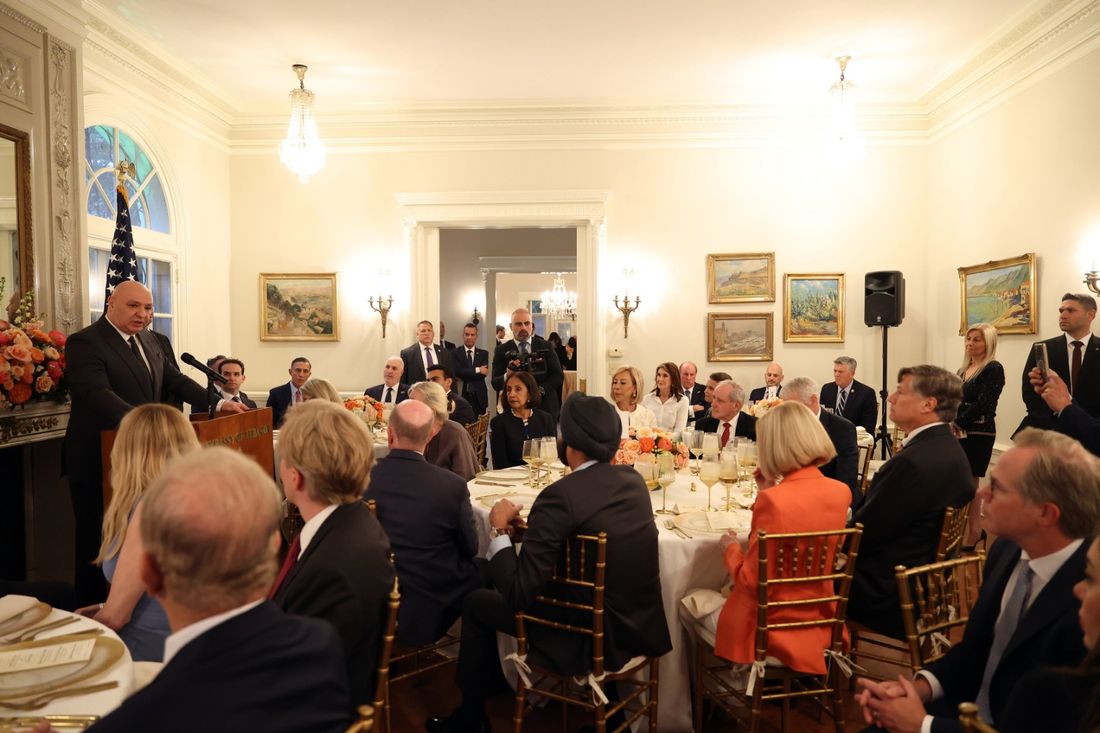
On the final day of his official visit to the United States, and before his return to Beirut today, Lebanese Ambassador to Washington Nada Hamadeh Mouawad hosted a dinner last night in honor of President Joseph Aoun and First Lady Nemat Aoun at the ambassador's residence. The dinner was attended by members of the accompanying Lebanese delegation, several members of Congress, and prominent US administration officials, including: Secretary of Energy Chris Wright; World Bank President Ajay Banga; Chairman of the Senate Foreign Relations Committee James Risch; Senators Jeanne Shaheen, Christopher Coons, Christopher Murphy, James Lankford, William Haggerty, John Reed, Joni Ernst, and Jackie Rosen; Chairman of the House Foreign Affairs Committee Brian Mast; and Representatives Darrell Issa, Darin LaHood, Abraham Hamadeh, Joe Wilson, Max Miller, and Debbie Dingell; Deputy Secretary of State Christopher Landau; Deputy Secretary of Commerce Paul Dabar; Deputy National Security Advisor Mike Needham; Under Secretary of Defense Elbridge Colby; and the US Ambassador. Lebanon has Michel Issa, Ambassador Michael Waltz, Ambassador Monica Crowley, Dr. Massad Boulos, Dr. Sebastian Gorka, several assistants to the Secretaries of State, Defense, and the Treasury, and senior directors from the National Security Council and the International Development Finance Corporation.
After the Lebanese and American national anthems were played, Ambassador Hamadeh Mouawad welcomed President Aoun and the First Lady, delivering a speech in which she said: “Your visit to Washington comes at a pivotal moment for Lebanon, reflecting our commitment to strengthening the historic ties between Lebanon and the United States, and working to achieve the aspirations of the Lebanese people for sovereignty, territorial integrity, security, prosperity, and peace. We are confident that this visit will contribute to opening a new chapter in Lebanese-American relations and strengthening the partnership between our two countries.” President Aoun then delivered a lengthy speech in which he said: “The friendship between our two countries is deeply rooted in history. Long before Lebanon became a modern state, Americans were already present there. This friendship is also evident in what America has built and defended in Lebanon: billions of dollars invested in the Lebanese Armed Forces, decades of support for our institutions, and one of the largest American diplomatic compounds in the world. But what binds us goes beyond history alone; it is about the very essence of what Lebanon is.”
He added: “Lebanon is not simply a country of eighteen recognized religious communities living within borders.” One. It is proof, for nearly a century, that these communities can share one homeland, one flag, and, God willing, one army, without any of them having to dissolve into the others. I am honored to be the only Christian head of state in the entire Arab world, and I say this not as a personal distinction, but because it reflects the unique model of coexistence in Lebanon, a system that can truly succeed, generation after generation, despite the worst that history has brought. This is something that deserves to be protected. Not only for Lebanon, but for the region, and it deserves to be protected because it is based on the same foundation upon which you built your nation. For nearly a hundred years, Lebanon has been a democracy. Through occupation, civil war, and economic collapse, our people never stopped voting, never stopped debating, and never stopped believing that it is their right to choose their rulers. Our democracy has been tested in ways that few other democracies have. It has bent, but it has never broken.
Aoun continued: In the last few years alone, our people have borne the burden of hosting the highest per capita refugee population in the world, and the horror The Beirut port explosion, a financial collapse that wiped out life savings overnight, a global pandemic, a political vacuum, and a devastating war—yet, Lebanon has not abandoned its country. Lebanon shares America’s belief that free people, free markets, and strong institutions make stronger nations. At a time when American interests have been targeted in this region, Lebanon has remained an exception. As both commander of the armed forces and president, I have made it a priority to ensure the protection of American interests and American personnel in Lebanon. But tonight, I cannot only speak to you about what Lebanon has protected; I must also speak about what Lebanon has lost.
He said: Lebanon is suffering immensely. Thousands of civilians have been killed, including many women and children who should have been safe in their homes. Entire villages have been destroyed. Whole families have been wiped out. Nearly one in five Lebanese has been displaced from their homes. For us, these are not statistics. They are our sons, our fathers, our neighbors, and our friends. Behind every number is a face, a name, a family, and a life. It has changed forever. As many of you know, I spent forty-two years of my life serving in the Lebanese Army, rising through the ranks to become its commander-in-chief. Those four decades instilled in me a conviction that I carry with me every day in this position: that Lebanon cannot be safe, nor can it be united, unless it is one state with one army, protecting all Lebanese without discrimination.
He explained, "This conviction is not a slogan for me; it is the mission of my presidency. Through it, I bear the responsibility of ending this war, helping those families return to their homes, rebuilding their communities, looking to the future with hope, ending the state of hostility with Israel once and for all, and consolidating the sovereignty of the Lebanese state. This responsibility is what brought me to Washington." "And I believe that, for the first time in years, we have a real opportunity to make history."
He added: "Moments like these only come around once a generation. Nations either recognize their value, or they spend another generation regretting not doing so. For almost fifty years, Lebanon has been a battleground for the conflicts and interests of others: Palestinian, Syrian, Israeli, Iranian, and yes, sometimes our own. But something new is happening today. Not By chance or luck, but by choice—our choice:
First, within Lebanon: Since assuming power, the state has worked decisively toward one goal: one state, one army, and the dismantling of illegal armed groups operating outside the state's authority. We are pursuing genuine reforms, working to end corruption, and rebuilding institutions that the Lebanese people can trust again. Every step we have taken proves the same thing: that this path—the path of a sovereign and responsible state—is not only the right one in principle, but the only one truly capable of ending the conflict and achieving the prosperity our people deserve. This is not a path we are taking alone; it is firmly supported by a clear majority of Lebanese, from all sects.
Second, in our surroundings: We have made a deliberate choice to restore Lebanon's relations in the region and the world, and to reposition Lebanon where it belongs—not as an arena for others' agendas, but as a sovereign state that rejects interference from any quarter, in any form. This choice has earned us renewed support from friends in the Arab world and beyond. Nowhere is this transformation more evident than with our neighbor, Syria. We are building a relationship with Damascus based on what it should always have been: an exclusive, state-to-state relationship founded on mutual respect, sovereignty, and non-interference in internal affairs. None of us wants a repeat of the tragedies caused by past interventions—tragedies that could have destabilized not only Lebanon, but Syria, and indeed the entire region.
Third, there is the United States: under President Trump's leadership, and through the tripartite framework his administration brokered between Lebanon and Israel last June, we now have the most serious American commitment to Lebanon's stability in decades. This framework was not reached by chance; it came about because your administration pushed for it, and because Lebanon was ready to make it a reality. And believe me, it is rare that internal will, regional support, and American leadership converge at the same moment. Tonight, they do. Aoun emphasized that the Lebanese Armed Forces are not merely an army; they are the only truly national institution that enjoys the trust of all Lebanese citizens, and the only force that belongs to no sect, party, or faction, but to Lebanon alone. They guard our land and maritime borders. They defeated ISIS on our soil, and they are our first line of defense against drug trafficking, organized crime, and smuggling across our borders. They work in cooperation with the Internal Security Forces to maintain public order and protect the vital infrastructure upon which our people depend every day. When disaster strikes—a flood, an explosion, a collapse—the Lebanese Army is always the first to respond, to every community, without exception. This is the institution in which we ask you to continue investing, because its record speaks for itself: a proven, tested, and trustworthy institution, and we ask you to grant it that trust. It is the same institution that the world will be watching closely as we grapple with the most difficult question this evening.
Let me address directly the question that I know is on everyone's mind tonight: Is disarming Hezbollah truly achievable? Yes, but only if we are honest about what it actually takes. The armed group we are talking about is not a foreign mercenary force; it is composed of Lebanese citizens who, over forty years, have been molded by a massive and sustained investment in ideology, society, and military strategy into a non-state armed group operating outside the control of the government. This reality does not make the objective less urgent, but rather the method more crucial. History offers a proven path, from the Revolutionary Armed Forces of Colombia to the Irish Republican Army in Northern Ireland, and it is not a mystery: disarmament, demobilization, and reintegration. It begins with removing the root cause that Hezbollah has always cited as justification for its existence: the Israeli occupation of Lebanese territory. This process continues with the Lebanese army assuming full and exclusive operational control, which requires immediate and unconditional support for our military forces, the sole legitimate defenders of this country. It culminates in reintegration: a reconstruction program managed solely by the Lebanese state, coupled with genuine economic opportunities, so that weapons are no longer the only option, but rather a choice between them and a functioning state that fulfills its promises. The equation is simple: a political path without an economic one results in a state that cannot compete. A strong state is the only alternative to the vacuum, which, if the state does not fill, others will assume.
At every stage of this process, the Lebanese state must be the party that exercises its authority over its territory, controls its borders, and holds the sole monopoly on the decision of war and peace within its borders. This is the path I have chosen, and it is the path I have come to Washington to ask you to take with us.
He added: Lebanon has long been known as a battleground for others' wars. I want the next generation to remember Lebanon not as a place where wars never ended, but as a place where peace finally prevailed. Not only because the weapons have fallen silent, but also because the state has become strong enough to protect its people, provide opportunities for its citizens, and build a future worthy of their talents.
This is the partnership we hope to build with the United States. I believe there has never been a better moment to build it, nor a more suitable partner to help us build it, than the United States.
During dinner, President Aoun and the guests engaged in conversation, discussing the situation in Lebanon and what the United States can offer to help restore the country's true image and enable it to play its long-standing role in the Middle East and the world. President Aoun also inquired about the situation of Lebanese people in the United States in general, and in Washington, D.C. in particular.