President of the Republic General Joseph Aoun stressed that preserving and strengthening the Christian presence in the Middle East requires consolidating the principles of statehood, justice, and freedoms, and confronting extremism and exclusion, because weakening any component of the region weakens the entire Middle East.
He said: "We do not want Christians in the East to live on the margins of their homelands. Rather, we want them to be full partners in shaping their future. We also want Muslims and Christians to stand united in protecting their countries. An East that loses its diversity loses part of its identity, while an East that protects its pluralism safeguards its future."
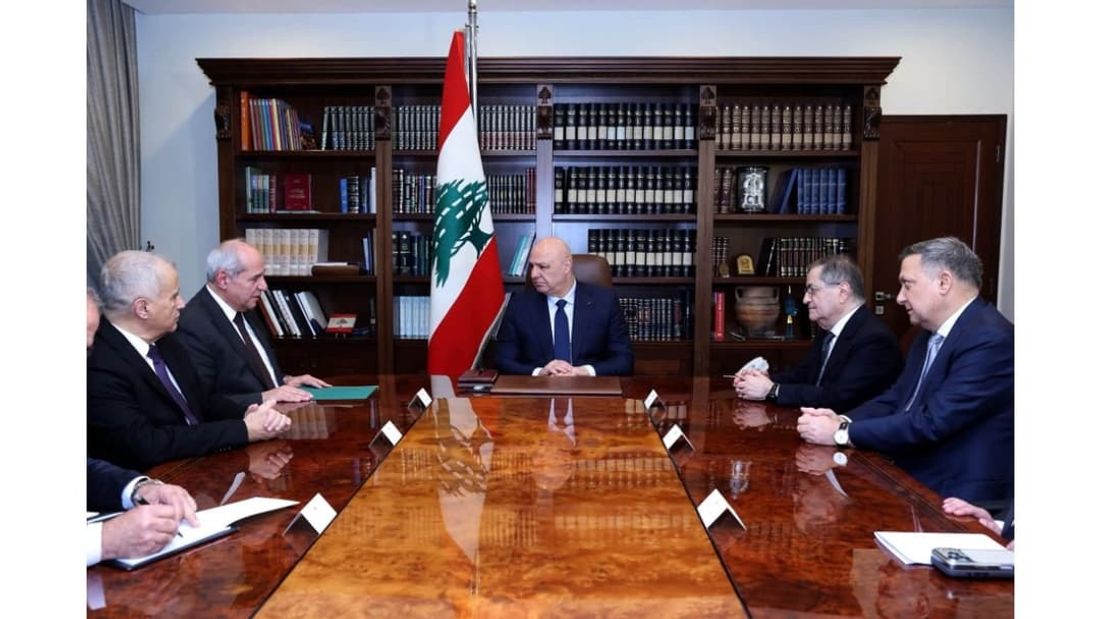
President Aoun made these remarks during a meeting this afternoon at Baabda Palace with a delegation from the Institute of Eastern Christians in Paris.
The delegation presented President Aoun with a copy of the appeal issued by academics who gathered in Rome on November 5 and 6, under the title "For a Peace That Does Not Betray Justice." The appeal was issued during an international conference entitled "Peace in the Face of the Challenges of a Troubled World" and "Eastern Christians: Conflicts and Peacebuilding."
The conference brought together academics from several countries, most of whom are affiliated with Catholic universities and represent different academic disciplines and traditions.
The delegation noted that the appeal emphasized the rejection of peace remaining merely an ideal that is proclaimed but whose realization is constantly postponed. It stressed the rejection of peace without justice, an international order that does not respect the law, faith that justifies violence, and knowledge that remains indifferent to human suffering.
The delegation requested the President's support for the initiative undertaken by the Institute of Eastern Christians, in cooperation with its partners, including universities, to promote peace, dialogue, citizenship, and pluralism, and to prepare for an international peace conference under the blessing of His Holiness Pope Leo XIV, who received a copy of the appeal and praised its content.
President Aoun told the delegation that protecting the Christian presence in the East cannot be separated from protecting Muslims, and that it must not be viewed as an issue concerning one sect or particular group, but rather as a shared national and humanitarian responsibility.
He stressed that Christians and Muslims are not merely two communities living side by side, but partners in history and destiny. Their coexistence must be based on citizenship, equality, and mutual respect, rather than on tolerance exercised by one side toward the other.
He added that Lebanon, with its religious and cultural diversity, represents a model and a message demonstrating the possibility of building a state in which Christians and Muslims share responsibility, decision-making, and a common destiny.
He concluded: "We do not want Christians in the East to live on the margins of their homelands. Rather, we want them to be full partners in shaping their future, just as we want Muslims and Christians to stand united in protecting their countries. An East that loses its diversity loses part of its identity, while an East that protects its pluralism safeguards its future."
Meeting with Parliamentary Delegation on UNIFIL
President Aoun also discussed the general situation in the country and the period following the withdrawal of UNIFIL forces with a parliamentary delegation comprising MPs Melhem Khalaf, Michel Moussa, Edgar Traboulsi, and Nasser Jaber.
Following the meeting, MP Melhem Khalaf stated:
"We had the honor of meeting His Excellency the President today to follow up on the initiative launched by 86 MPs, concerning the commitment to maintaining the international umbrella represented by UNIFIL forces in southern Lebanon.
"This meeting reaffirmed the continuation of efforts on this initiative, through which we are introducing a new proposal that would allow a message to be addressed to the United Nations General Assembly, through its President, requesting the inclusion of an urgent agenda item concerning the continued presence of UNIFIL, and asking the General Assembly to issue a recommendation to the Security Council calling for its retention.
"This is the third phase of the initiative, which everyone knows we are pursuing. President Aoun was fully committed to seeing this effort through, and I believe he expressed a positive attitude toward the initiative."
He added: "There is a very important point that His Excellency the President emphasized, concerning indications that there is no acceptance of a security vacuum. In other words, there is international and UN acceptance of our position that southern Lebanon must not be left without this force or international umbrella.
"Work is underway to finalize an alternative arrangement that would provide protection for southern Lebanon and Lebanon as a whole, as part of these efforts in international forums."
Asked whether President Aoun had received positive indications from influential capitals, particularly Washington and Paris, regarding an extension of UNIFIL's mandate as currently proposed, Khalaf replied:
"There are no specific indications, but rather information that the President is gathering through his contacts, particularly through our ambassadors in New York and Washington. He is personally following up on this matter to prevent a vacuum in the South following the departure of this international umbrella, and efforts are underway to avoid such a vacuum."