A new discovery has emerged, a discovery NASA says was made by chance. While testing a radar system over northern Greenland, a team of NASA scientists discovered a base that was part of an ambitious and secret Pentagon plan, known as Project Iceworm, to build a network of nuclear missile launch sites under the Arctic ice.
The United States has long sought control of Greenland, given its strategic and economic importance.
Since returning to the White House, US President Donald Trump has doubled down on his long-standing ambitions to acquire Greenland, even not ruling out the use of military force or economic coercion to gain control.
While Denmark has always refused to sell the autonomous territory, Washington has maintained a military presence in Greenland since World War II.
The US military has built numerous bases and outposts across Greenland's ice sheet, most of which were abandoned or decommissioned after the Cold War.
According to Business Insider, during the Cold War, Greenland's massive ice cap was the biggest challenge to a top-secret, legendary project: the creation of a subterranean tunnel city designed to store hundreds of nuclear missiles within launching distance of the Soviet Union.
After its construction in 1960, Camp Century was presented to the public as an Arctic research facility, but the US administration didn't disclose the secrecy of the missile operation until 1995.
Although it was known as a research facility, its true nature was not revealed until 1996. According to the Wall Street Journal, it was intended for secret military purposes.
Construction of the facility began in 1959 at a cost of $8 million and is located about 150 miles from Thule Air Base, a major Arctic defense center.
The facility was named "Camp Century" because it was initially planned to be located 100 miles from the Greenland ice sheet.
According to Business Insider, the camp endured harsh winter conditions, including winds reaching 125 mph and temperatures as low as -70 degrees Fahrenheit.
Members of the U.S. Army Corps of Engineers transported 6,000 tons of supplies and materials to the site to dig nearly two dozen underground tunnels covered with steel arches and a layer of snow. The underground base was completed in late 1960.
The largest trench at Camp Century, known as "Main Street," was approximately 26 feet wide and spanned 1,000 feet. The sprawling underground complex housed up to 200 personnel.
Engineers drilled a well at the camp to provide 10,000 gallons of fresh water per day, and insulated and heated pipes were extended throughout the facility to provide water and electricity.
The camp also included a kitchen and cafeteria, a medical clinic, a laundry area, a communications center, and dormitories. The facility also included a recreation hall, a chapel, and a barbershop.
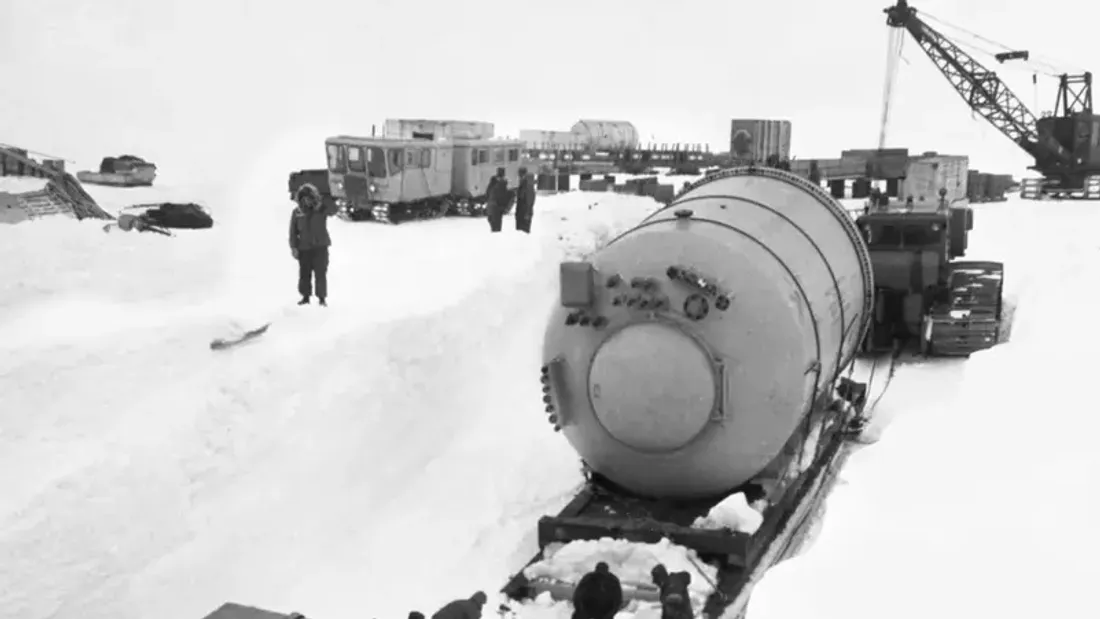
Camp Century operated a 400-ton portable nuclear reactor, the first of its kind. Due to subzero temperatures, which make the metal extremely brittle, the PM-2 reactor had to be handled with extreme care to protect it from damage. It operated for approximately three years before being deactivated and removed from the facility.
The facility was intended to analyze ice sheet conditions, glacier movement, and cold-weather survival.
However, this was merely a cover for a top-secret American operation, known as Project Iceworm, to store and deploy hundreds of nuclear-tipped ballistic missiles in an attempt to circumvent Denmark's strict nuclear-free policy while exploiting Greenland's proximity to the Soviet Union.
Iceworm sought to expand the existing facility by an additional 52,000 square miles to accommodate 60 launch control centers.
The facility was planned to store up to 600 Iceman missiles, modified two-stage intercontinental ballistic missiles with a range of up to 3,300 miles.
The project was also seen as a potential means of securing alliances and sharing nuclear weapons with other NATO countries, particularly France.
However, the project faced significant challenges, including bureaucratic hurdles, modifying the Iceman missile to withstand extreme cold conditions, and continuing underground operations as the Greenland ice sheet became increasingly unstable.
After only three years of construction at Camp Century, the Army decided not to risk losing hundreds of missiles if the facility collapsed, leading to the cancellation of Project Iceworm.
The facility continued to operate at limited capacity before being shut down in 1967. Since then, the U.S. Army has not conducted any removal of the waste and infrastructure, assuming it will eventually be buried under the ice sheet.
In a statement to the Wall Street Journal, a doctor who served with the US forces during the Cold War revealed that the base stretches approximately two miles and was equipped with a nuclear reactor that had been dragged through the ice for more than 130 miles.
Now, researchers have taken stock of what remains and found approximately 136 acres of waste. A 2016 study revealed more than 50,000 gallons of diesel fuel, 63,000 gallons of wastewater and radioactive coolants, and thousands of gallons of sewage.
They also found an unknown amount of polychlorinated biphenyls (PCBs) still buried in the abandoned facility.
At the current rate of Arctic ice melt, researchers estimate that the waste could surface around 2100, releasing pollutants that pose a significant threat to surrounding ecosystems and human health.
With the growing threat of biological, chemical, and radioactive waste, the question remains: who is responsible for cleaning up the waste from Century and other abandoned US military installations scattered throughout Greenland?
In 2018, Greenland and Denmark signed an agreement allocating $29 million over six years to clean up some US military bases. Efforts were postponed in 2021 due to the COVID-19 pandemic.