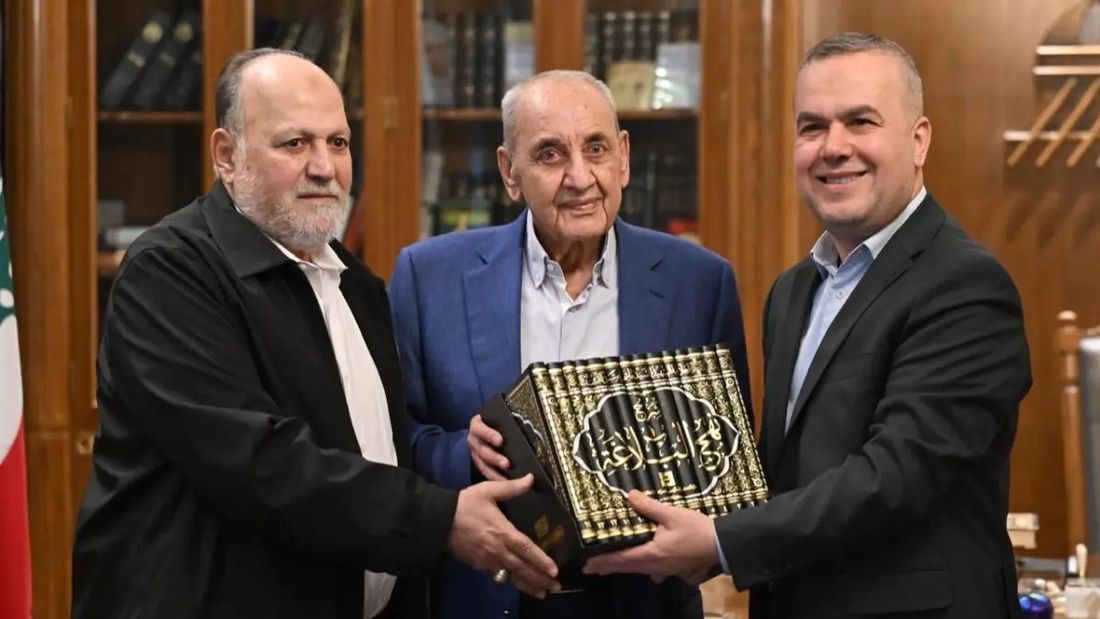
Speaker of Parliament Nabih Berri met with MPs Ali Ammar and Hassan Fadlallah, members of the Loyalty to the Resistance parliamentary bloc. They discussed general developments, the latest political and field developments, particularly in southern Lebanon in light of Israel’s continued attacks and destruction of villages and homes, as well as legislative and national affairs.
The meeting also provided an opportunity for the two MPs to present Speaker Berri with a collection of Nahj al-Balagha commentaries on Imam Ali, authored by the late former Hezb0llah Secretary-General Sayyed Hashem Safieddine, in his memory. It was the first copy of the collection.
Following the meeting, MP Hassan Fadlallah said:
“Conversations with Speaker Nabih Berri always begin with the South, that sacred land steeped in the blood of resistance fighters, where the fists of its people are raised—the fists of those who remain steadfast and committed to their land, villages and homes. We discussed the ongoing attacks against the people of the South and the operations carried out by the enemy to bulldoze land and destroy homes, as everyone witnessed in Zawtar al-Sharqiya, Hadatha and other southern villages.”
Fadlallah continued:
“We discussed the position that all of us in Lebanon must adopt in response to these attacks. It must be a position grounded in the unity, resilience and steadfastness of our people, who are presenting the entire world with an example of patriotism and genuine belonging to Lebanon. The steadfastness of the people of the South is the measure of national loyalty; patriotism is measured from that place. Our hearts will always remain with the South.”
He added:
“We then discussed a number of domestic and regional issues, particularly the ongoing negotiations between the Islamic Republic of Iran and the United States. This issue is of fundamental importance to us because, if these negotiations succeed and lead to an agreement, the Islamic Republic of Iran has affirmed that Lebanon will remain a top priority in efforts to halt the aggression against it and compel Israel to withdraw from Lebanese territory.”
Fadlallah stressed that “the Islamic Republic deserves our gratitude for this position. All of us in Lebanon must appreciate its solidarity with our country. Today, it may be standing at the forefront, regionally and internationally, in supporting our right to liberate our land. The Islamic Republic has never withheld its support for Lebanon—neither in the past nor in the present, and, God willing, not in the future—in order to help liberate its land and impose its sovereignty over all its territory.”
He continued: “Therefore, our hopes will remain pinned on the Islamabad track, as it is the opportunity available today, after we have seen the results of the framework agreement and the direct negotiations, which failed to produce any outcome. On the contrary, the Israeli enemy is exploiting this process to intensify its attacks against our country.”
On domestic affairs, Fadlallah said:
“There was complete agreement on the need for a degree of calm and de-escalation within the country. Lebanon does not need escalatory rhetoric or language that divides the Lebanese. What is needed today is national discourse that matches the historic steadfastness of the people of the South and helps ease internal tensions.
“There is no need to inflame tensions at home. The Lebanese already have enough to contend with in the enemy’s escalating actions against our country. Neither our people nor the Lebanese as a whole need escalatory or inciting rhetoric that contributes to division, rather than promoting national unity and bringing people together in the face of what Lebanon is experiencing.
“Unfortunately, there are always those who seek to drive the Lebanese apart. In discussions with Speaker Nabih Berri, he consistently calls for what unites people, not what divides them. This has always been his well-known position.”
Fadlallah said that two additional issues were discussed, including the budget and the allocations that must be included in the state budget for reconstruction.
“Of course, the Council of the South is playing a major role, for which it deserves appreciation, despite its limited resources. We raised this issue in the Finance and Budget Committee and again during today’s discussion.
“We are dealing with structural repairs, structural reinforcement, displaced people, destroyed and evacuated villages, as well as the damage inflicted in Beirut’s southern suburbs and the Bekaa. This entire file must be treated as an urgent priority by the government. It is unacceptable for it to remain hostage to political disputes while the Lebanese are distracted by other issues and essential matters are ignored.
“In any case, we have set out a roadmap for following up on this file.”