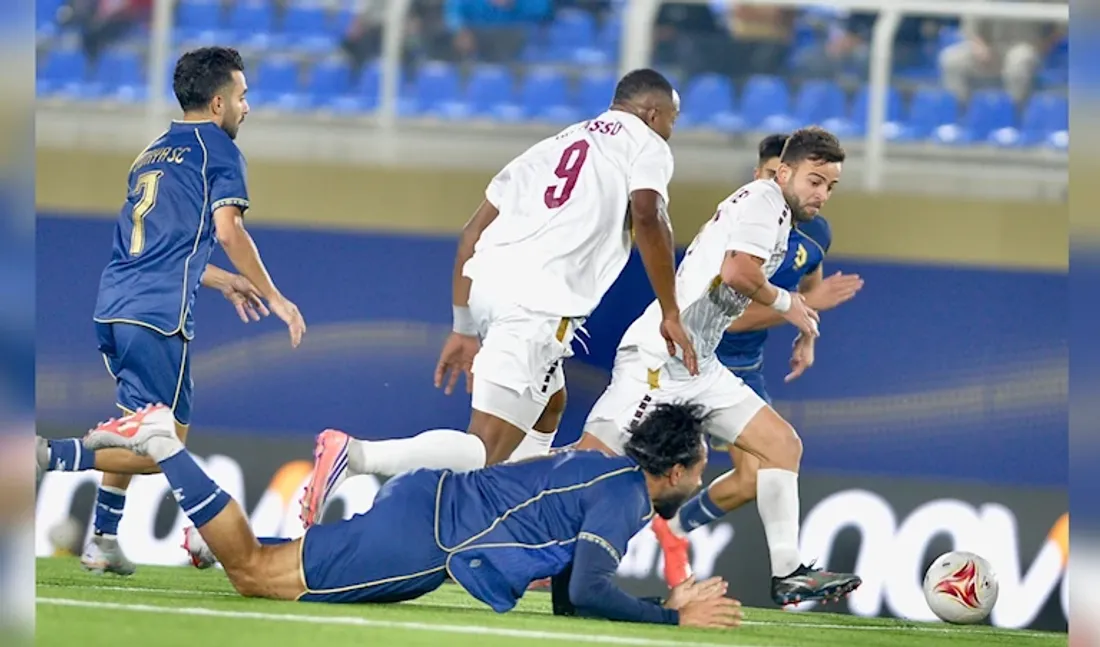
The match between Jwaya and Nejmeh, part of the fifth week of the Lebanese Football League, ended on Sunday at Jwaya Stadium, but its repercussions continued more than 48 hours after the final whistle. The disappointment left Lebanese football fans shocked by the poor quality of the game, the incidents that accompanied it, and the subsequent social media frenzy. What lies behind the tension between the two clubs and their supporters?
Former star player Abbas Atwi, known as "Onika," perhaps summed up the entire scene when he described what happened on the pitch between Jwaya and Nejmeh players as shameful, saying it was as though they were engaged in an act of "revenge."
Atwi spoke in a friendly and brotherly manner, drawing on his experience as a former player and his love of football, expressing his desire to see entertaining matches. In a video posted on his Facebook page, he argued that the players, rather than the fans or referees, were responsible for ruining the match. He advised them to remember that they are professional footballers and are expected to uphold that standard by delivering quality football instead of pushing, fighting, and constantly confronting referees.
Captain "Onika" hit the nail on the head, voicing the frustration of many who were disappointed by a match they had eagerly anticipated between two of the strongest title contenders and two of the most heavily invested clubs among Lebanon's 12 football teams.
The match between Jwaya and Nejmeh at Mohammed Saeed Saad Al-Jamil Stadium in Jwaya represented an investment of approximately $14 million to $15 million in terms of the stadium's cost and the budgets of both clubs, in addition to the expensive Video Assistant Referee (VAR) technology.
Lebanese football fans had expected an exciting encounter, particularly as it was the first major clash this season between two of the four title contenders: Ansar, Nejmeh, Ahed, and Jwaya.
However, the anticipated football feast turned into what could be described as a bland hospital meal, lacking both taste and color. Instead, spectators witnessed shameful scenes involving prominent international players pushing and fighting one another while repeatedly protesting against the referees, who delivered an excellent performance in a highly charged and tense encounter and successfully brought the match to a peaceful conclusion.
The worst part came after the match, both immediately following the final whistle and the next day, with statements followed by a "war of insults" on social media.
Some may argue that what was said on social media came from ordinary supporters, which is normal. However, a considerable number of comments and videos were posted by individuals very close to senior officials at both clubs. This raises questions about whether there was a coordinated signal or encouragement behind the attacks, which carries its own implications.
Wissam Saad and Rami Baytar Emphasize Their Strong Relationship and Friendship
The situation reveals considerable tension in relations between the two clubs, particularly among their senior officials, despite the exchange of voice messages and phone calls between Jwaya President Wissam Saad and Nejmeh Chief Executive Officer Rami Baytar, which suggest otherwise.
The scene between the two clubs could be summed up by the saying: "I like what you say, but I am surprised by what you do."
But what led to this point between two clubs with such different histories? Jwaya is a relatively new club, playing only its second season in the first division, while Nejmeh has a long-established history.
Several indicators point to a cooling of relations between the two sides. Even the scene in the stadium's VIP section during the match, particularly the seating arrangements and the distance between representatives of both clubs, reinforced this impression.
Al-Akhbar contacted senior officials from both clubs to understand the reasons behind the tension and obtain each side's perspective.
At Nejmeh, when asked about the reasons for the tension, officials refer back to last season and the first match between the two teams in Jounieh during the first leg of the 2025–2026 league season. They point specifically to the arrival of some supporters wearing black masks and the insults they directed at others.
"The sensitivity and provocations began that day and continued until the end of the season," a member of Nejmeh's administrative committee told Al-Akhbar.
Nejmeh officials, along with representatives of other clubs, also point to statements made by Jwaya officials, particularly President Wissam Saad and Chief Executive Officer Basel Saad, whether in media interviews or during the team's presentation ceremony on October 7.
An administrator from a third club commented: "No official at any club can say, 'We are here to rule football.' That is a huge statement, and nobody rules football in Lebanon."
Nejmeh officials also recalled several issues they claim to have encountered during their three visits to Jwaya Stadium.
"How is it possible for the water supply to be cut off from Nejmeh's dressing rooms on three separate occasions, forcing the team to wait for a water tanker to arrive? Why should the team have to wait 12 minutes outside its dressing room because the room is locked and the person holding the key is on their way to open it? Then, suddenly, after Jwaya coach Algerian Miloud Hamdi objects to what is happening, an electronic card appears that opens the door. Why is it that only at Jwaya Stadium do some Nejmeh supporters, whose identities are unknown to the fan club officials, throw water bottles, while this does not happen at other stadiums? And why are water bottles allowed into the stadium in the first place?" one club official said.
At the same time, Nejmeh Chief Executive Officer Rami Baytar emphasized in a phone call with Al-Akhbar the strength of his relationship with Jwaya Club and expressed his deep affection for the three brothers Wissam, Basel, and Wael. He also praised their significant investments in Lebanese football.
He concluded: "I wish there were five more people like Wissam, Basel, and Wael Saad in Lebanese football."
For his part, Jwaya President Wissam Saad appears to share حاج Rami's position regarding Nejmeh and its officials.
When asked whether there was tension between Jwaya and Nejmeh, Saad quickly replied: "God forbid! I just spoke with Rami and told him, 'Your reputation is my reputation, and your family is my family.' Relations between the two clubs are excellent, particularly between Rami and me. In fact, they are more than excellent, and friendly communication is ongoing. What happened during and after the match was nothing more than isolated behavior that should have remained confined to that context," the Jwaya president told Al-Akhbar.
Asked about statements he had made that Nejmeh supporters considered provocative, Saad laughed and said: "These are motivational statements intended to inspire the team and create competition, not hostility, especially toward Nejmeh. There is nothing personal between me and my friend and brother Rami. Even if these statements were interpreted differently, I stress that they were nothing more than a way to motivate the team," Wissam Saad added.
Regarding the complaints raised by Nejmeh officials about Jwaya Stadium, Saad said: "There may sometimes be operational details that require quick attention, but nothing is intentional. Jwaya Stadium is Nejmeh's stadium as well, as demonstrated by the fact that it was made available to Nejmeh last season. I even informed حاج Rami this season that the stadium would be at his disposal if the team qualified for the AFC Challenge League. I reiterate that relations with Nejmeh and its officials are excellent. End of discussion."
Jwaya Club President Wissam Saad concluded his remarks to Al-Akhbar.
𝗦𝗼𝘂𝗿𝗰𝗲: 𝗮𝗮𝘄𝘀𝗮𝘁