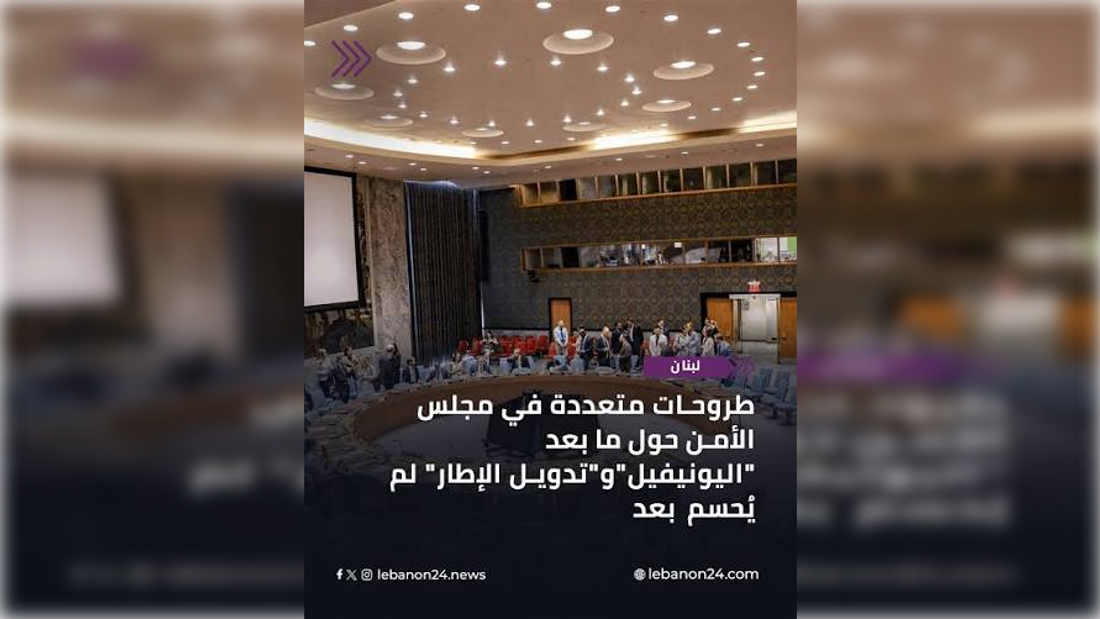
Lebanon is once again awaiting new deliberations at the UN Security Council, with a session expected possibly today, Tuesday, or next week. Discussions could continue until shortly before the end of the year, in hopes of reaching a consensus among member states on the formation of a force to replace UNIFIL after its mandate expires at the end of this year. Meanwhile, France is working to prepare a draft resolution in December to fill the security vacuum in southern Lebanon.
According to information obtained by Al-Liwaa from official sources, the main idea behind the proposed draft is for UN forces remaining in the south during their gradual withdrawal to continue monitoring, surveillance and reporting activities, while assisting the Lebanese Army and civilians in their villages. This arrangement would remain in place until the final withdrawal, possibly within the first six months of 2027, by which time the Security Council is expected to have agreed on an alternative formula.
However, the issue of who will take over the positions evacuated by UNIFIL remains unresolved, raising concerns that Israeli occupation forces could expand into these locations in the occupied villages, where approximately 30 positions are involved.
Al-Liwaa also reported that US Ambassador to the United Nations Mike Waltz did not present any American proposal for a solution during the Security Council deliberations, instead leaving the matter to France.
Paris, in its capacity as the penholder on the Lebanon file, is seeking to draft a text with UN backing that combines Resolution 1701, with certain amendments, and the provisions of the tripartite Framework Agreement between Lebanon, Israel and the United States. The aim is to prevent a security vacuum on the ground once UNIFIL forces begin withdrawing in early 2027.
France reportedly informed member states of its intention to prepare a UN draft resolution during the coming month, with drafting set to begin next week. The draft is expected to include arrangements for an orderly transition from the current mission to a new mechanism, while examining possible adjustments to the pace of withdrawal and the retention of certain capabilities, particularly communication and coordination mechanisms between the Lebanese and Israeli armies.
According to the same information, the French proposal includes retaining approximately 2,000 to 3,000 troops during the gradual withdrawal period. France's Minister of the Armed Forces has also begun contacts with Israel to discuss the proposed formula, which has not yet been finalized.
An-Nahar reported that Lebanese officials are awaiting the initial findings of consultations that are expected to gain momentum at the United Nations, particularly between the United States and France, aimed at agreeing on an alternative to UNIFIL after its withdrawal from southern Lebanon begins at the end of this year.
Available information about these consultations does not suggest much optimism, given the significant differences in international positions so far, casting considerable doubt over the upcoming discussions. These efforts will be racing against time, with only the coming month of December available to reach an agreement on a formula to fill the vacuum left by UNIFIL and secure the approval of the countries concerned.
In this context, a source following the developments told Al-Anbaa Electronic that France is attempting to accommodate the American position by proposing two possible formulas for the post-UNIFIL phase.
“The first formula involves deploying a multinational force in the south to assist the Lebanese Army, a proposal that Speaker of Parliament Nabih Berri is concerned about. This is because such a force, once deployed in Lebanon, would not necessarily require a UN mandate and would enjoy international support, without facing objections from Russia or China, particularly following the recent trilateral summit held in China. Its primary mission would be to assist the army in reorganizing areas and extending its control,” the source said.
“On the other hand, Paris is seeking a faster and more flexible way out by reactivating the role of the United Nations Truce Supervision Organization (UNTSO) and strengthening its personnel, logistical and financial capabilities,” the source added.
While awaiting the outcome of discussions among the various parties involved in the Lebanon file, the main challenge for Lebanon remains ensuring that a change in the form of the international presence does not translate into a change in the rules governing sovereignty and security in the south, particularly regarding the borders and the need to uphold the internationally recognized boundaries and the Blue Line.
According to information obtained by Al-Joumhouria from sources following the ongoing consultations, both among the countries concerned and at the level of the UN Security Council and the United Nations, “no alternative has yet emerged that could take over UNIFIL's mission in the south, and the atmosphere is not encouraging.”
The sources attributed the lack of progress to the fact that Paris is keen to maintain a presence in southern Lebanon, whether through forces mandated by the United Nations, not necessarily on the same scale as the current UNIFIL deployment, or even through the deployment of exclusively French troops under a UN mandate or another arrangement.
Israel, however, rejects a repeat of the UNIFIL experience and opposes any role for the United Nations. It also categorically rejects any meaningful French role in southern Lebanon. The United States is fully aligned with the Israeli position and is unwilling to grant France any role.
The sources added that US Ambassador to the United Nations Mike Waltz's announcement about the intention to incorporate certain elements of the Framework Agreement into the Security Council resolution expected before the end of next month on the post-UNIFIL phase amounts to little more than a declaration of intentions.
An official source told Al-Joumhouria that Lebanon does not object to the deployment of any international forces under the United Nations flag, even at a smaller scale than UNIFIL, but stressed that the fundamental condition is that such forces remain bound by the provisions of UN Security Council Resolution 1701.