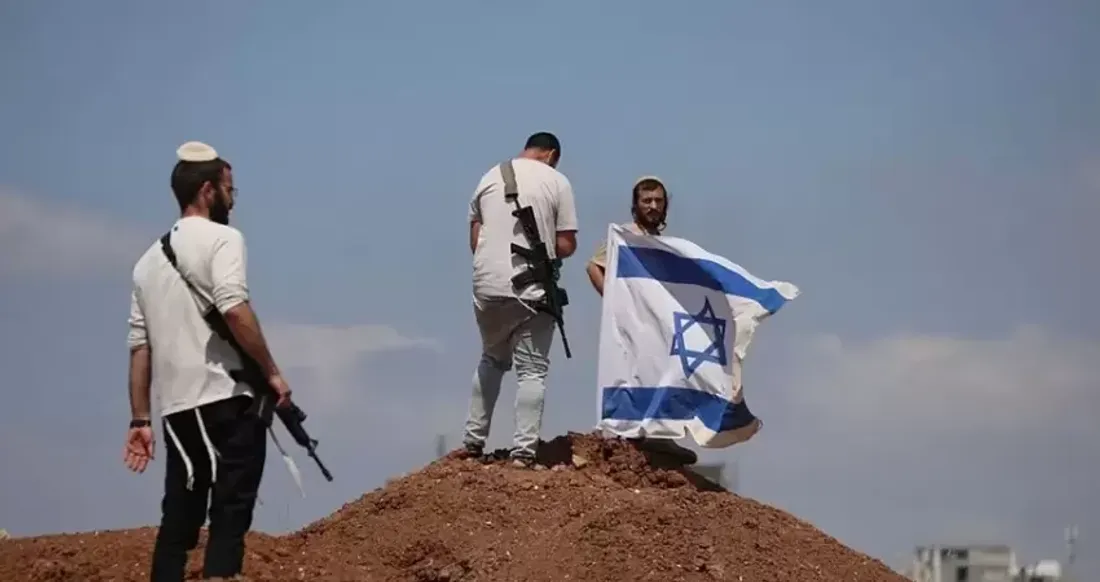
At the height of political polarization and partisan competition among Israeli forces, the issue of settlement stands out as one of the contentious topics, and it has returned to the heart of the security debate, as it now exacts heavy prices from the occupation.
Col. Amir Nevi, former commander of the operational coordination cell with the US military and a security and political commentator, stated that "after Jewish settlement, which since the beginning of Zionism was a central tool in building the state and demarcating its borders, shifted from the Labor movement to Religious Zionism, it simultaneously transformed from a project that cut across party camps into a partisan political issue, although this change is not limited to the reality on the ground."
Nevi added in an article published by Maariv that "after 1967, settlement in the West Bank and the Gaza Strip began to take on religious dimensions, from Gush Emunim formerly to Religious Zionism currently, after rabbis adopted the old Zionist project and endowed it with a new national-religious meaning, which highlighted a gradual paradox: the very idea of settlement, which a generation earlier was attributed to the Labor movement, has increasingly come to be attributed to the religious."
Nevi explained that "strategically, the picture was more complex than the political division that arose later. The Allon Plan proposed Jewish settlement in the Jordan Valley from a security, separation, and strategic control perspective; the 1973 document also addressed the continuation of settlement in the territories. In other words, the idea of settling these areas did not originate in Gush Emunim, and was not originally the exclusive preserve of the right."
He affirmed that "as Religious Zionism became the pivotal force in settlement in the West Bank, the language also changed: the term 'building the land' turned into 'the settlement enterprise,' and the settler was no longer merely a person who settles the land, but became a symbol of political controversy. Derogatory epithets also appeared in public discourse, such as compound terms made up of 'settlers' and 'terrorists,' expressions that became part of political discourse in the 1980s and 1990s."
Nevi pointed out that "2005 marked the next important milestone in this process, as the disengagement plan did not end with the evacuation of Gush Katif in Gaza alone; four settlements in the northern West Bank were also evacuated: Ganim, Kadim, Homesh, and Sa-Nur, and no permanent Israeli civilian presence remained in the area. The withdrawal turned the theoretical question into a practical test: is it possible to separate settlement from the concept of regional security?"
He added that "in the years following the withdrawal, Hamas and Islamic Jihad infrastructure was established in the northern West Bank, particularly in the Jenin area, constituting one of the most prominent challenges there, which manifested in large-scale military operations to thwart this infrastructure in those areas. Security studies linked the withdrawal to the emergence of a security vacuum and the renewed strengthening of armed organizations. Although the causal relationship between the withdrawal and the scope of operations is disputed, the security operation that followed returned the northern West Bank to being a strategic area."
He explained that "after years in which settlement was viewed in some parts of Israeli discourse as a problem to be solved, a different perspective began to take shape, namely that settlement is a tool for creating a foothold. During 2023-2024, the legal restrictions on returning to those settlements in the northern West Bank were lifted, in 2025-2026 the government made decisions to re-establish and regulate them, and in 2026, settler families began returning to them."
He relayed "supporters of this step, including government ministers, the settlement regional council, and settlement officials, saying that it markedly improves security, as it forms a security belt for the cities of the center and north, and a key pillar for Israeli army activity in the area, while its critics and some experts see this step as a security burden and a source of tension."
He affirmed that "history will judge which of the two camps was right, but after the settlement project transformed from a shared Zionist project, though one that underwent a change in its human composition, it became a political and partisan symbol, and returned to strategic discourse based on the security reality that later emerged."
These lines present an Israeli reading that the strengthening of settlement in the occupied territories has gone beyond national and political dimensions to become a tool in the hands of competing parties on the one hand, and an attempt to impose a religious cover on the settlements on the other, costing the occupation more losses and human and security prices.