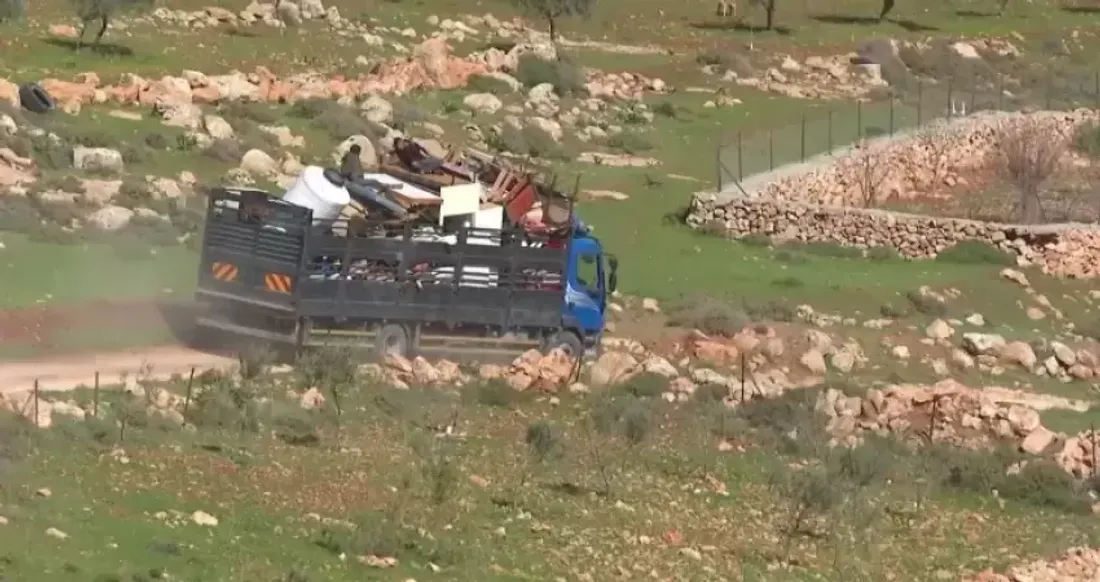
The Palestinian Central Bureau of Statistics and the Environment Quality Authority revealed that settler attacks and settlement expansion caused the displacement of 118 Palestinian herding communities and groups in the West Bank between 2023 and 2025, amid escalating control over land and pastures and the denial of Palestinians' access to water sources.
A joint statement by the two institutions, issued Wednesday on the occasion of Arab Environment Day, explained that the area of pastureland in the West Bank is about 2,111 square kilometers, equivalent to roughly 37% of its area, while the pastures of the eastern slopes make up about 61% of the total pastureland.
The statement noted that 185 new settlement outposts were established in the West Bank between 2023 and 2025, including about 130 herding outposts and settlement hills, whose controlled land is estimated at about 1.07 million dunams, equivalent to roughly 18% of the West Bank's area.
It added that about 300,000 dunams were added to the land seized by settlers through these outposts in 2025 alone, while the number of herding settlement outposts in the West Bank reached 231, out of about 400 settlement outposts.
According to the statement, the number of settlers in the West Bank reached about 790,000 by the end of July 2026, distributed across 170 settlements and 400 outposts.
It pointed out that Israeli control extends to 42% of the West Bank's area, 71% of Area C, and about 91% of the Palestinian Jordan Valley, while Israeli military orders allocated 16,200 dunams for settlers' herding activity and legalized 70 agricultural and herding outposts.
Regarding land seizure, the statement said that during 2024 the occupation authorities issued about 35 seizure orders covering 1,073 dunams, five expropriation orders for about 803 dunams, and nine orders declaring about 24,597 dunams as state land, in addition to six orders amending the boundaries of nature reserves, through which about 20,000 dunams were seized.
Repercussions for livelihoods and food security
The statement stressed that the loss of pastures and restricted access to them increase herding families' dependence on purchased fodder and raise the costs of raising livestock, threatening their ability to continue their livelihood activities, in addition to the impact of land-use changes and road construction on the continuity of natural habitats and biodiversity.
In the Gaza Strip, the statement indicated that the latest geospatial assessments issued by the UN Food and Agriculture Organization and the UN Satellite Centre showed that only 4,480 dunams of agricultural land, about 3% of the total agricultural area, were accessible and undamaged as of June 24, 2026.
It explained that these figures limit the capacity for agricultural production, fodder supply, and livestock preservation, and worsen the difficulties of restoring livelihoods and strengthening food security.
The Central Bureau of Statistics and the Environment Quality Authority stressed the importance of protecting pastures and managing them sustainably, calling for stronger coordination among national, international, and regional institutions, and for support for rehabilitating affected areas and protecting biodiversity and natural habitats, so as to help preserve Palestinian natural resources and strengthen the steadfastness and food security of herding communities.