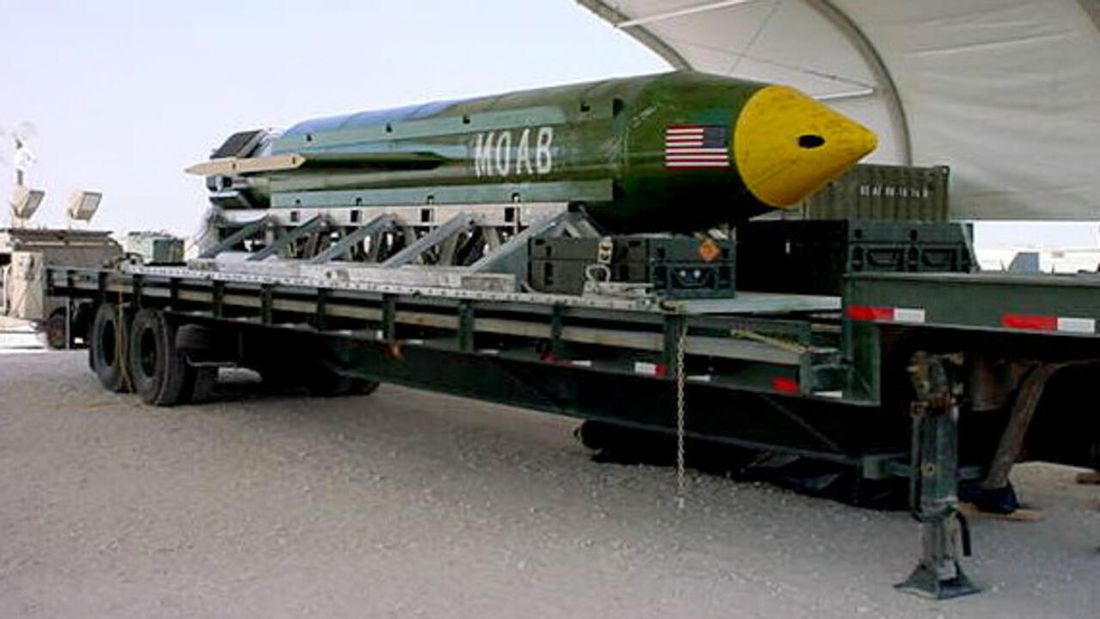
According to media reports by CNN, the U.S. military continues to provide President Donald Trump with military options against Iran, including strikes targeting large-scale infrastructure. The reports added that the United States is considering using the “Mother of All Bombs” against Iran. So, what do we know about this weapon?
The GBU-43, also known as the Massive Ordnance Air Blast (MOAB), is commonly referred to as the “Mother of All Bombs.” It is one of the most powerful conventional non-nuclear bombs in the U.S. military’s arsenal and contains 8,482 kilograms of the highly explosive H6 mixture. The bomb detonates shortly before reaching the ground and measures 9.1 meters in length and 103 centimeters in diameter.
Designed in 2002 and entering service the following year, the bomb is guided by satellite navigation. It is deployed from an MC-130 aircraft. The GPS-guided bomb is released from the cargo ramp of a C-130 transport aircraft, while a parachute slows its descent, allowing it to be dropped from high altitude and giving the aircraft’s crew sufficient time to reach a safe distance.
The MOAB was designed as a blast weapon that detonates before impact. According to the U.S. publication Wired, its thin aluminum casing enhances the blast effect, generating a shock wave that can extend up to 150 meters.
The bomb disperses a massive cloud of highly explosive material around the target before igniting it, producing an explosion with enormous destructive power. The MOAB can penetrate to a depth of approximately 200 feet (60 meters) before its warhead detonates.
The GBU-43 was designed to be used against large concentrations of enemy forces on the battlefield and to intimidate other adversaries. In 2003, it was described as one of the most powerful non-nuclear bombs in modern military history and one of the most formidable strategic weapons in the U.S. arsenal.
The bomb was developed in 2002 and 2003 by Dynetics, an aerospace and defense company, in cooperation with the U.S. Air Force Research Laboratory. According to the company’s website, the initial concept was transformed into a detailed design plan within just three months, and the weapon underwent three successful tests over a period of 13 days.
Fifteen GBU-43 bombs were produced for potential use during the early stages of the Iraq War in 2003, but Washington ultimately chose not to deploy them.
In 2009, military sources within the U.S. Department of Defense (Pentagon) revealed that the department had considered using the weapon against Iran amid tensions over Tehran’s nuclear program. The consideration was reportedly based on the bomb’s ability to destroy strategic weapons concealed deep underground.
The GBU-43 was designed to replace the BLU-82, known as the “Daisy Cutter,” which weighs approximately 6,800 kilograms. The BLU-82 was used during the Vietnam War to clear landing zones for U.S. helicopters and to clear minefields.
The BLU-82 was also used as a psychological warfare weapon against Iraqi forces during the 1991 Gulf War. In 2001, it was deployed in Afghanistan against tunnels believed to be hiding places for members of al-Qaeda.