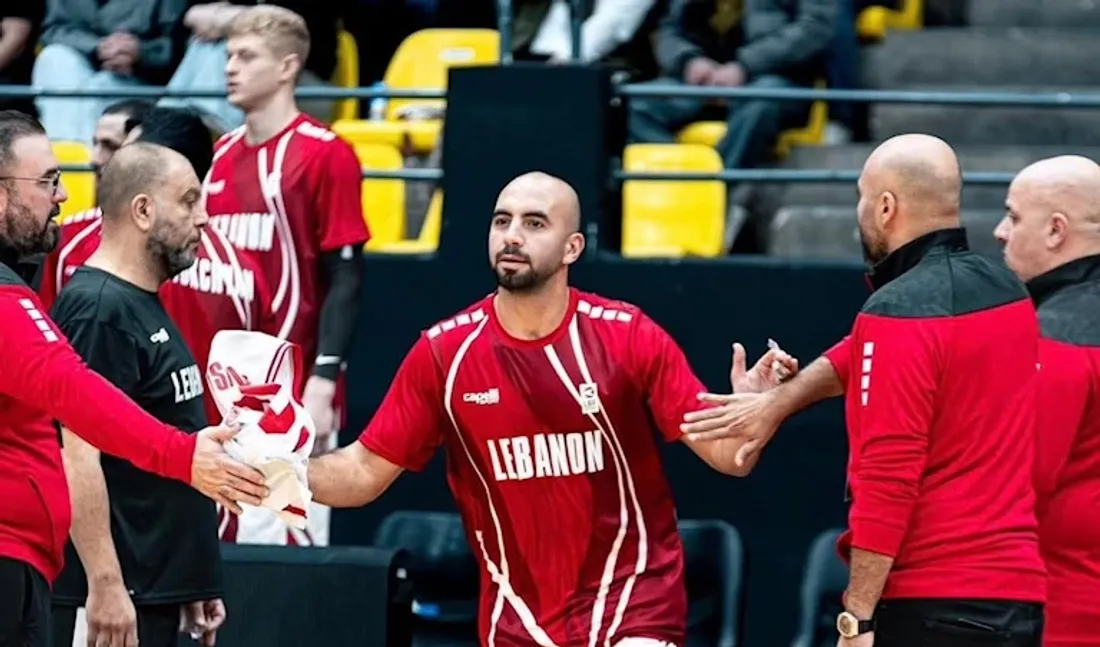
Lebanon’s national basketball team has completed a preparatory training camp in the Jordanian capital, Amman, during which it played two friendly matches against Jordan. Each team recorded one win and one loss. The Cedars won the first game 89–79 but lost the second 100–97.
The results of these matches were not particularly important. The main objective was for the coaching staff to assess the players’ readiness and test defensive and offensive strategies ahead of Thursday’s match against Japan and Sunday’s game against China in the World Cup qualifiers.
There is no doubt that head coach Ahmad Farran has taken note of every aspect of the squad, which is missing Jihad El Khatib and Wael Arakji as they recover from injuries. During this week’s training sessions, Farran will also have Sergio El Darwich, Mark Khoury and naturalized player DJ Vanderhorst, who joined the national team after completing their club commitments in Japan and Greece.
Lebanon’s journey toward qualifying for the World Cup for the fifth time in its history, following its appearances in 2002, 2006, 2010 and 2023, is not particularly difficult. In terms of the numbers, the team has four games remaining: two at home during this “window” against Japan and China, followed by two away matches in the sixth and final window next February against South Korea and Japan.
Lebanon needs to win two of its four remaining games to secure qualification, regardless of other results.
If Lebanon wins two matches, it will qualify directly. Winning just one of the four games could also be enough, provided that it does not lose to South Korea by more than 20 points in the final window, although such a scenario is theoretically difficult to achieve. However, to avoid any risks or complicated calculations, the national team must aim to win its home games in front of its fans in Zouk this week. That would allow it to enter the sixth window having already secured qualification, giving the coach the freedom to test as many players as possible and give them an opportunity to prove themselves ahead of the Basketball World Cup.
Farran currently has 15 players at his disposal, including Ali Mezher, Ali Mansour, Jad Khalil, Amir Saoud, Karim Zeinoun, Omar Jamaleddine, Joe Abou Samra, Sergio El Darwich, Mark Khoury, Youssef Khayat, Haik Gyokchian, Gerard Hadidian, Omar El Jamal, Derek Vanderhorst and newcomer Karim Ezzedine.
These are genuinely talented players, combining experience with youth, as was evident in the two preparatory games in Jordan. Haik Gyokchian delivered a particularly impressive performance, while the other players, especially the younger ones, also showed consistent form.
As usual, Farran will rely on the defensive approach that has become his trademark, aiming to prevent opponents from scoring the points they are accustomed to. His philosophy is simple: a team that defends well also attacks well—and ultimately wins.