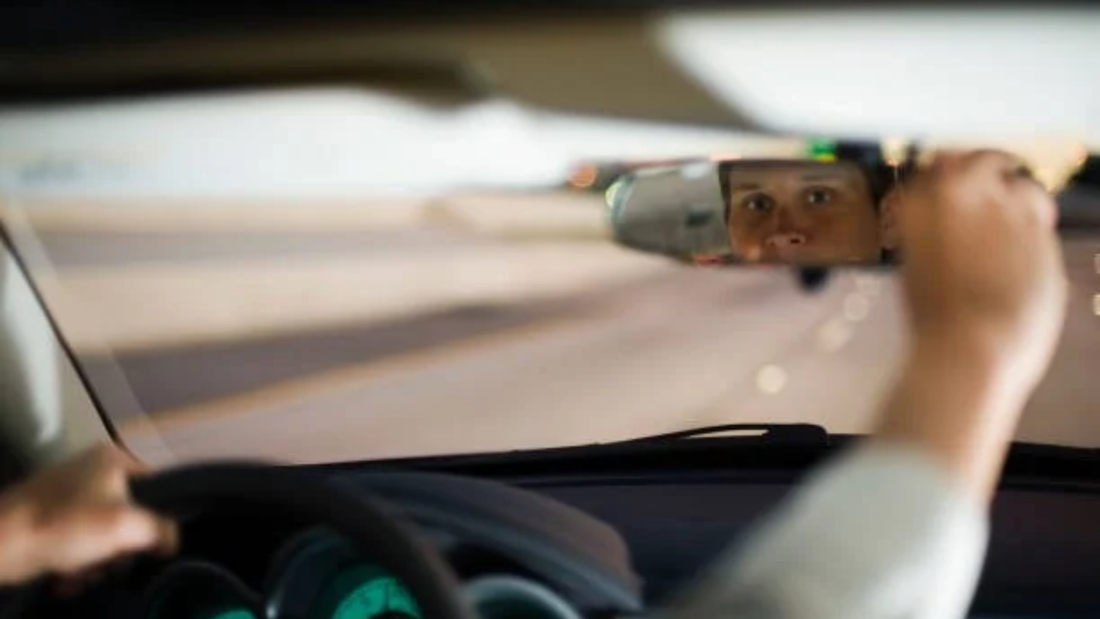
Many cars have a small switch beneath the interior rearview mirror. Drivers may overlook it for years without knowing its actual purpose, or assume it is simply part of the mirror's design.
However, this switch serves an important function, particularly when driving at night, as it helps reduce the glare from the headlights of vehicles approaching from behind.
This feature is known as Day-Night Mode. It offers a simple way to reduce glare from the headlights of vehicles behind your car without having to completely change the mirror's position or lose sight of the road.
How Does It Work?
The switch beneath the mirror slightly changes its tilt angle when moved, reducing the intensity of the light reflected into the driver's eyes.
This technology relies on a special design used in traditional rearview mirrors. They feature wedge-shaped glass with a reflective coating positioned behind it.
When the mirror is in daytime mode, the driver sees the stronger reflection from the rear reflective coating, providing a clear image of the road and vehicles behind the car.
However, when the switch is moved to night mode, the mirror's angle changes, directing the stronger reflection away from the driver's field of vision. The driver then sees the weaker reflection from the front surface of the glass.
As a result, the headlights of vehicles behind appear less bright, helping reduce glare that could distract the driver or cause discomfort when driving in the dark.
When Should You Use It?
Activating night mode is useful in several situations, most notably:
* Driving on dark roads: When the headlights of vehicles approaching from behind reflect directly into the driver's eyes.
* Heavy traffic: When vehicles behind move closer and their lights become more bothersome.
* Night driving in difficult visibility conditions: When headlight glare makes it harder to concentrate on the road.
However, it is advisable to return the mirror to daytime mode when driving in natural light, as night mode makes the reflected image darker, potentially reducing the visibility of details behind the car during the day.
Auto-Dimming Mirrors
Some modern cars no longer require this manual switch, as they are equipped with Auto-Dimming Rearview Mirrors. These mirrors use light sensors to detect the intensity of light coming from behind and compare it with the ambient light in front of the vehicle.
When the sensors detect strong glare from the headlights of vehicles behind, they send an electrical signal to a special layer inside the mirror known as electrochromic material. This layer gradually darkens, reducing the amount of reflected light reaching the driver's eyes.
Once the glare disappears, the mirror gradually returns to its normal brightness without requiring any action from the driver or the movement of a switch.
Some modern cars also offer this feature in their side mirrors to reduce glare from vehicles approaching from behind and alongside the car.