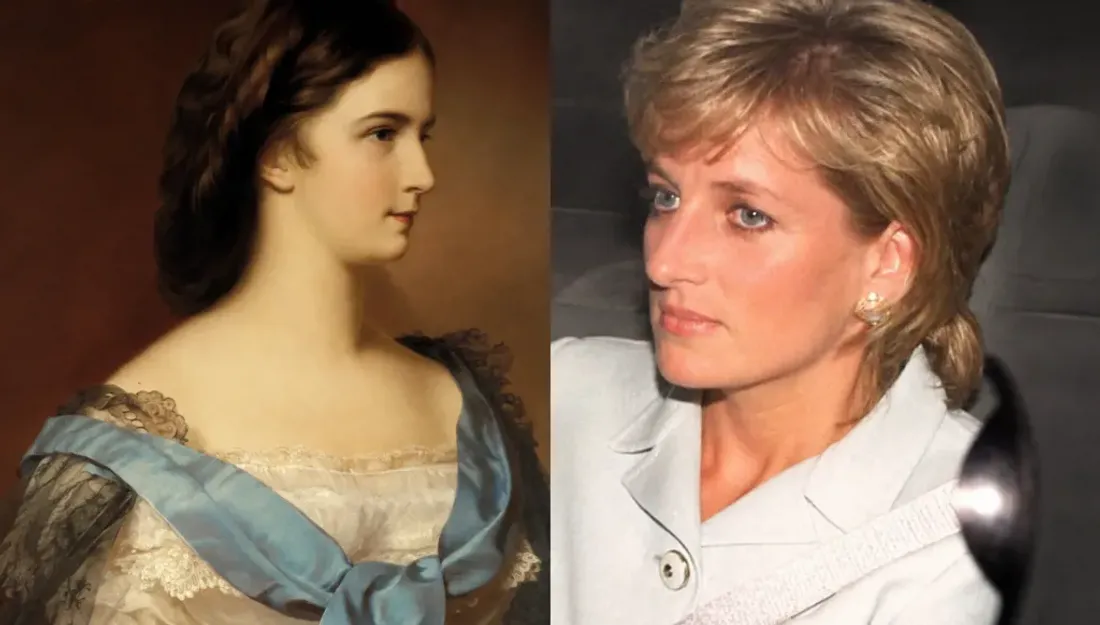
We have long followed the story of Lady Diana, the "People's Princess", who captured the hearts of millions with her humanity and defiance of some of Britain's strict royal traditions. From her marriage, which turned into a troubled relationship, to her humanitarian work and tragic death in an accident that remains etched in public memory, her story has remained one of the most influential royal tales. Yet what many may not know is that a woman who lived in Vienna more than a century before the Princess of Wales was born experienced a life with striking similarities to Diana's. She was Empress Elisabeth of Austria, better known as "Sisi".
Sisi entered one of Europe's most powerful royal families at the age of 16, becoming an overnight sensation who attracted widespread public attention. She clashed with her domineering mother-in-law, rebelled against palace traditions, supported marginalized groups, and endured a complicated marriage before her life came to an abrupt end in an assassination.
Netflix has brought her story back into the spotlight with its German historical series "The Empress", which consists of three seasons. The final season premiered on November 12, 2026. The series takes viewers into the court of one of Europe's most famous and controversial royal figures, portraying a life shaped by love, power, rebellion, and family tragedies.
Since its debut, the series has attracted fans of historical dramas and royal stories, particularly viewers of "Bridgerton" and "The Crown". With the release of its final season, questions have resurfaced about the real life of the empress portrayed by actress Devrim Lingnau, and how closely the events audiences have watched on screen reflect the experiences of a woman who, like Diana, lived between the splendor of the throne and the constraints of royal life.
Sisi... A Rebellious Empress Since Childhood
Elisabeth Amalie Eugenie of the House of Wittelsbach was born on December 24, 1837, into the Bavarian royal family. She was the third child of Duke Maximilian Joseph and Princess Ludovika of Bavaria. She grew up in the Bavarian countryside, far removed from the strict rules of palaces and royal protocol. Her childhood was spent riding horses and exploring forests, experiences that helped shape her love of freedom and independence.
Her family called her "Sisi", a name that stayed with her and later became part of her historical image. Her fame was not based solely on her royal status, but also on her striking beauty and unconventional personality. She practised sports and gymnastics and paid close attention to her appearance and physical fitness. She was also known for smoking cigarettes and having a tattoo, actions that were unusual for a woman of her standing at the time.
Unlike the traditional image of an empress, Sisi disliked official appearances and public ceremonies. She tried to avoid court duties whenever possible and found in travel a way to escape the restrictions imposed on her.
A Love Story That Did Not Begin as We Saw It
The series' storyline overlaps with the historical account in one key aspect of the relationship between Elisabeth and Emperor Franz Joseph I, but the details of their first meeting were different.
In reality, the marriage between the emperor and Elisabeth was not planned from the outset. Their mothers had hoped that Franz Joseph would marry Elisabeth's older sister, Helene, a detail also portrayed in the series. However, the emperor fell in love with Sisi when he first saw her in her mother's salon, not during a chance encounter in the forest, as some of the series' dramatic scenes might suggest.
According to the empress's biography, written by historian Brigitte Hamann and titled "The Reluctant Empress", Franz Joseph was captivated by Elisabeth as soon as he saw her and formally proposed to her through family channels. When Sisi learned of his interest, she is said to have expressed her feelings by saying: "I love the emperor. If only he weren't an emperor."
Nevertheless, the two married on April 25, 1854. Elisabeth was 16 years old at the time, while Franz Joseph was 23.