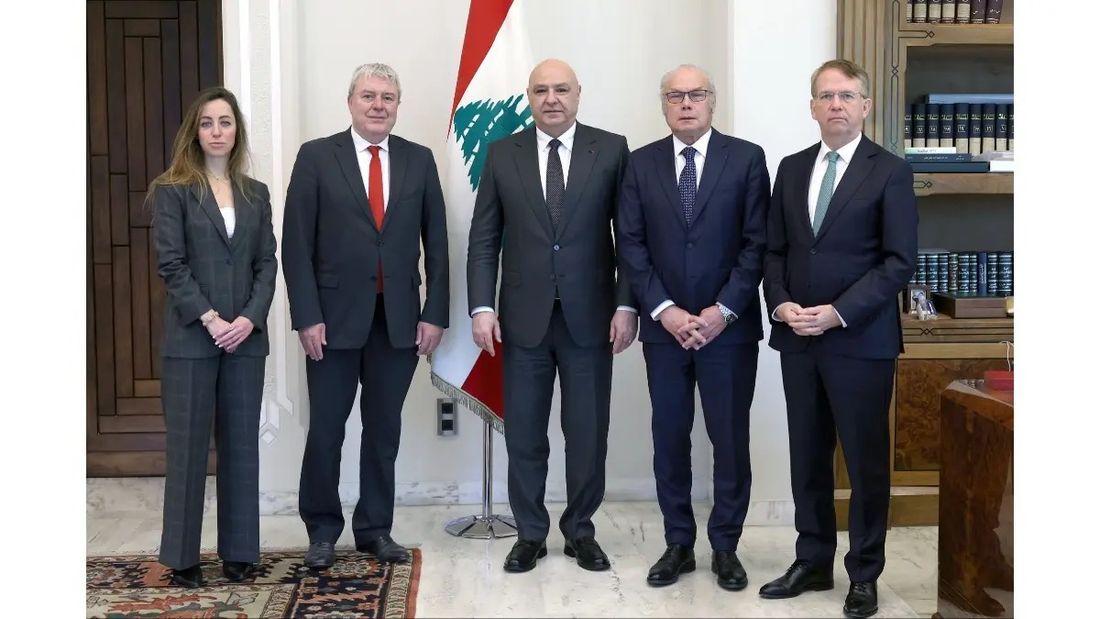
A delegation of French parliamentarians, comprising Carole Guillaume, Pierre Pribetich and Jean-Paul Lecoq, visited Lebanon’s three top officials, accompanied by French Ambassador to Lebanon Hervé Magro.
At the beginning of the meeting, the delegation members congratulated President Joseph Aoun on the 83rd anniversary of Lebanon’s Independence, commending his speech on the occasion and the responsible positions he has adopted to help build Lebanon’s future.
President Aoun welcomed the French parliamentary delegation and briefed its members on the current situation in Lebanon in general, particularly in the south. He thanked France for its continued support for Lebanon, as well as French President Emmanuel Macron for his positions and the assistance France has provided to Lebanon, particularly during the difficult circumstances the country has faced. The latest such support was the preparatory conference held in Paris ahead of the international conference to support the Lebanese Army and Internal Security Forces.
President Aoun noted that “at this stage, attention is focused on the period following the end of UNIFIL’s mission in southern Lebanon.” He pointed out that “Lebanon and France share identical views regarding either extending the forces’ mandate or enabling them to continue carrying out their duties throughout 2027, the year designated for their withdrawal, while ensuring that no security vacuum emerges. Any alternative force must operate under the United Nations flag, with UN Security Council Resolution 1701 serving as its legal framework, subject to possible amendments when necessary.”
President Aoun outlined the tasks that any force replacing UNIFIL could undertake if an extension of its mandate proves impossible. These include:
- Providing logistical support to the Lebanese Army and assisting in dismantling unexploded ordnance, dealing with tunnels and addressing weapons depots, if any are found.
- Providing humanitarian support to communities in the south by helping reopen roads and assisting residents in returning to their villages.
- Carrying out monitoring and reporting activities.
Lebanon is awaiting a UN Security Council session scheduled for late this month to learn more about developments.
In response to questions from the delegation, President Aoun stressed that “Israel continues to carry out hostile acts in the south, including demolishing homes and shelling villages from time to time, with the shelling recently extending to the Bekaa region.”
He noted that “the trilateral negotiations have been suspended due to the Israeli elections, in the hope that meetings will resume following the formation of the new Israeli government.”
Aoun emphasized that “the return of residents to their villages and towns in the south is one of the main objectives of the negotiations.” He explained that some displaced residents have returned to areas not under occupation, while awaiting the withdrawal of Israeli forces from occupied towns, the deployment of the Lebanese Army there, reconstruction efforts and the return of their residents. He expressed hope that Arab and European countries would contribute to the reconstruction process.
President Aoun reiterated that “Lebanon’s stability is essential and necessary for Europe, particularly since Lebanon is Europe’s gateway to the Arab world and the Arab world’s gateway to Europe.”
The delegation also visited Prime Minister Nawaf Salam. Discussions focused on developments in Lebanon and the region, the need to maintain a United Nations presence in southern Lebanon after UNIFIL’s mission ends, and the reform process the government is working to implement.
The delegation subsequently met with Foreign Minister Youssef Raggi. Its members reaffirmed the strong ties between the two countries and France’s unwavering support for Lebanon, its sovereignty and territorial integrity. They also praised the government’s courageous decisions aimed at strengthening the country’s sovereignty and ensuring that weapons remain exclusively in the hands of the state.
Minister Raggi explained that efforts are underway to develop a framework for the next phase that would safeguard Lebanon’s sovereignty and maintain stability in the south.