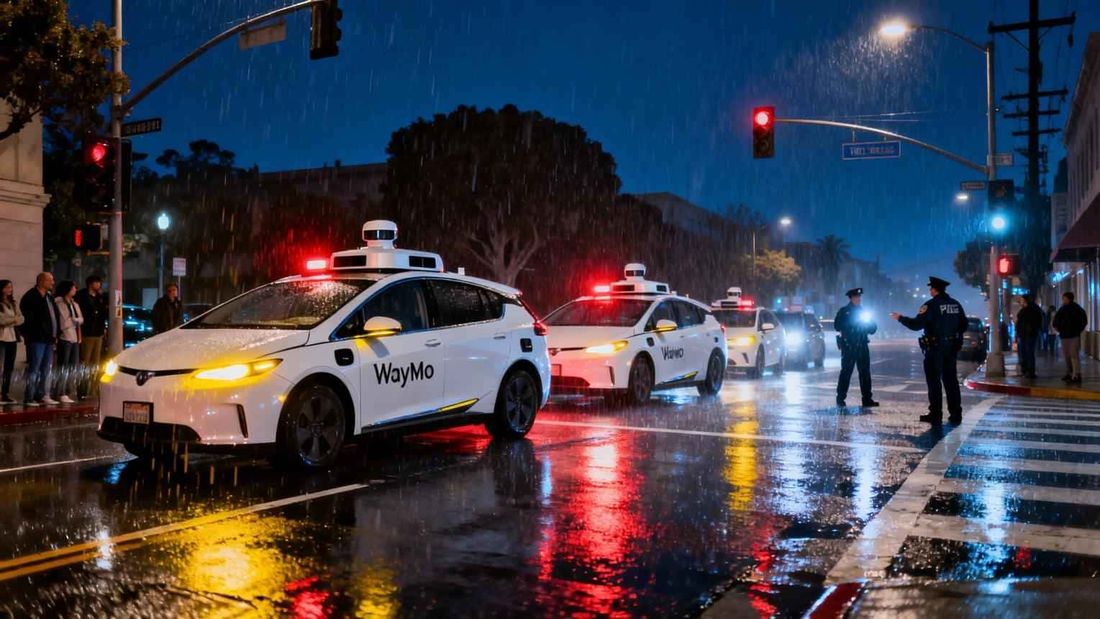
The vehicles stopped in the middle of the streets were not caught in traffic or experiencing a conventional mechanical failure. They were driverless taxis that found themselves unable to continue after rainwater flooded roads and intersections in the US city of San Francisco.
In a scene that astonished pedestrians and drivers, robotaxis came to a halt in the floodwater, forcing other vehicles to change course to get around them. Technology once hailed as a revolution in transportation had become a new source of congestion during the storms.
Heavy Rain Disrupts Traffic
The San Francisco Bay Area experienced heavy rainfall last week, causing water to accumulate and flooding several streets and intersections. The conditions exposed the difficulties self-driving cars face when navigating severe weather.
Users shared videos showing Waymo vehicles stopped in the middle of flooded roads, while other cars attempted to maneuver around them to avoid disrupting traffic.
At one location on Oak Street, near the Panhandle district, a self-driving car was seen stranded in the water, forcing drivers to maneuver around it as water flowed across the road.
Another vehicle also struggled to move at the intersection of Fell and Mason Streets. It took approximately half an hour of remote technical support attempts before the company's team managed to move it to a safer location.
Waymo Suspends Its Services
As weather conditions deteriorated and the risk of flooding increased, Waymo announced that it was suspending its self-driving taxi service in the San Francisco Bay Area during the storms.
The company explained that it had been monitoring the storm's progress before it arrived and had taken steps to reduce the number of vehicles in operation. It then temporarily suspended the service until road conditions improved and weather forecasts became clearer.
This was not the first time the company had encountered difficulties caused by rain. It had previously suspended its services in other US cities after incidents in which its vehicles entered flooded roads and subsequently became immobilized.
The Limitations of Smart Cars
Self-driving cars rely on a complex combination of cameras, sensors, radar, and software to analyze their surroundings and make driving decisions without direct human intervention.
However, heavy rain can affect the ability of some sensors to read the road. Accumulated water can also conceal road features, curb boundaries, and obstacles beneath the surface.
These vehicles face an additional challenge when deciding whether to continue moving or stop when a road becomes unsafe, particularly when weather conditions change rapidly.
Last May, the US National Highway Traffic Safety Administration (NHTSA) announced a recall of 3,791 vehicles equipped with Waymo's self-driving systems after discovering that some software could allow vehicles to enter roads covered with standing water. This could lead to a loss of control and increase the risk of accidents.
Coping with Extreme Weather
These incidents have reignited debate over how prepared self-driving technologies are to operate in all conditions. Success on dry, well-maintained roads does not necessarily mean these vehicles can handle floods, snow, fog, and storms.
Experts believe that developing this technology requires improving sensing and decision-making capabilities, alongside introducing stricter systems to prevent vehicles from entering flooded roads.