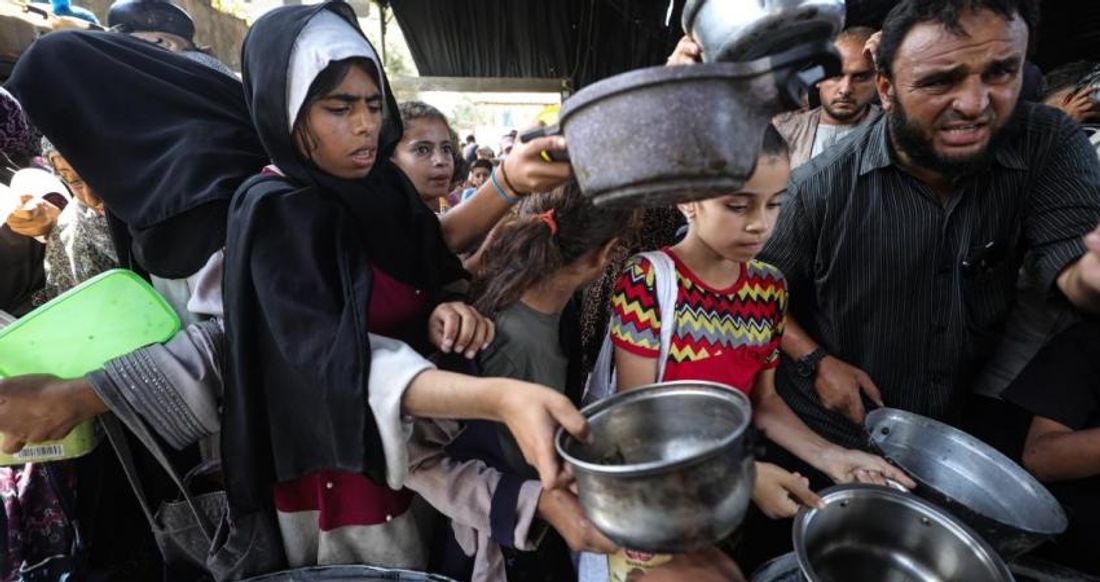
Palestinian Nihaya al-Masri spends up to six exhausting hours a day in the crush and jostle in front of a charity kitchen in the Gaza Strip, hoping to get some food for her family, as the tragic humanitarian conditions persist even a year after the ceasefire was announced.
Despite the agreement, which was supposed to allow food aid to flow into the devastated and besieged Strip, hunger remains widespread among Gaza's residents. Al-Masri has few options.
The 35-year-old woman told Agence France-Presse that without the kitchen run by humanitarian organizations, she and her eight children would have "nothing at all." In hope of getting a meal, al-Masri leaves her tent in the Khan Younis area in the south of the Strip early every morning, and returns only in the afternoon carrying four containers of rice, lentils and a little chicken, which is the only meal her family shares after long hours of waiting.
Among the family's ten members is Nihaya's husband, who was wounded in both legs in an airstrike, which means he "cannot go and jostle with others" and wait for food. Al-Masri says the family must consume very carefully the small amount of flour it has.
In August 2025, the Integrated Food Security Phase Classification (IPC), a UN-backed body, declared a famine in Gaza. Israel quickly denounced the declaration, calling it a lie. By December, the UN had lifted the classification, explaining that the ceasefire had allowed sufficient supplies to enter over two months to ease the crisis.
COGAT, the Israeli Defense Ministry body responsible for civil affairs in the occupied Palestinian territories, told AFP that the humanitarian situation in Gaza is stable.
However, Sean Hughes of the UN World Food Programme warns that "the food security situation remains extremely serious." He added that the latest available data, from July, show that "1.4 million people out of about 2.1 million suffer acute food insecurity," including 200,000 people "who are just one step away from famine."
"A person does not recover from it"
Although some food items have entered the Strip, the lack of sufficient dietary diversity remains a health threat. Hughes explains that "dietary diversity is one of the main problems linked to food security in Gaza." He added: "One cannot live on dry foodstuffs, wheat flour and bread alone. Children, and pregnant and breastfeeding women in particular, need the micronutrients found in protein-rich foods, fresh vegetables and fresh fruit."
Al-Masri says her children, aged between three and 14, "dream of eating fruit," but the family does not have enough money to buy it. She adds that one of her sons suffered malnutrition during the 2025 famine, "but his condition is gradually improving." Malnutrition results not only from a lack of food but also from a lack of essential nutrients, as it weakens children's immune systems, makes them more susceptible to illness and affects their growth.
Hughes says that "children's exposure to repeated bouts of acute malnutrition is something from which a person does not fully recover," adding that the mental and physical damage it causes "continues into later stages of life."
At Nasser Hospital in Khan Younis, the head of the malnutrition unit, Isra al-Najjar, told AFP that she has "noticed an increase in syndromes and medical conditions" linked to malnutrition and affecting the immune system.
In a report published Thursday, Médecins du Monde said a study it conducted revealed that 93% of pregnant or breastfeeding women suffer symptoms of anemia closely linked to malnutrition. The study concluded that only 17% of women have a diet varied enough to meet their nutritional needs.
Amid all this, al-Masri keeps going to the charity kitchen despite suffering from asthma that exhausts her severely. But her family is also working to improve its poor living conditions, as her children spend their days collecting "pieces of nylon, cardboard and sponge" in an attempt to reinforce their dilapidated tent. She considers it "shameful" that her children are forced to do this, adding: "I swear to God, this is not normal."