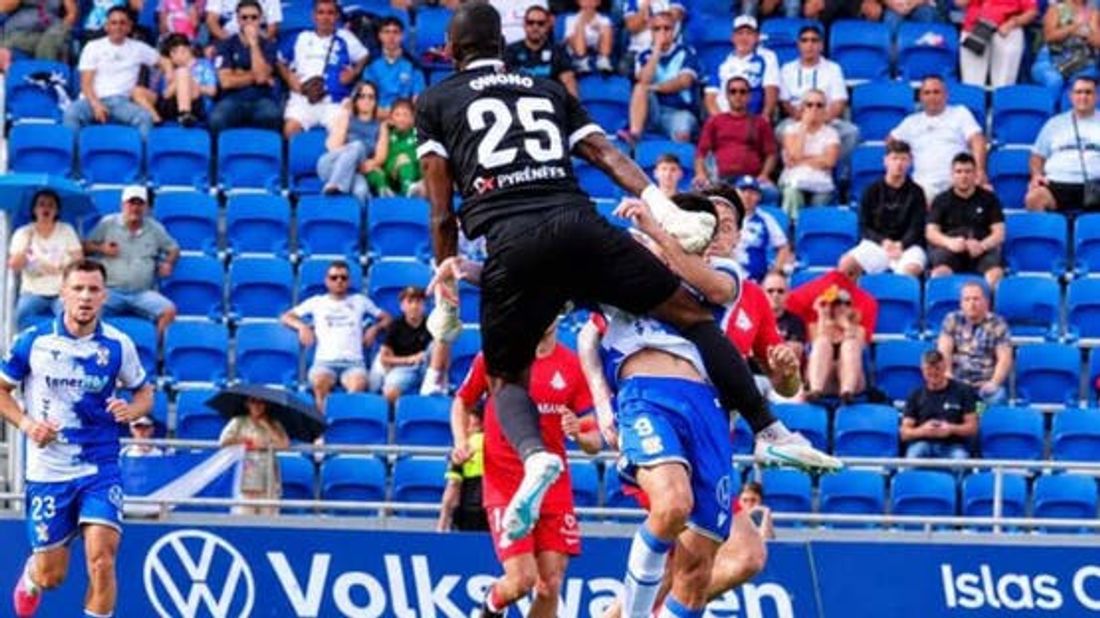
Miguel Galán, a sports law expert, has outlined his position on the potential legal consequences facing Jesús Owono, FC Andorra’s goalkeeper, following the tragic death of Jesús de Miguel, a Tenerife player, after a forceful collision between the two that caused the striker to suffer cardiac and respiratory arrest.
Galán, who received dozens of questions on social media about the possibility of holding Owono criminally liable, said Spanish courts clearly distinguish between incidents that occur in the course of play and those that are unrelated to it.
In explaining his position, Galán referred to a Spanish Supreme Court ruling (STS 379/2025), issued on April 30, stressing that “the Supreme Court’s current approach in cases involving challenges for a loose ball and late tackles points towards dismissal of criminal proceedings or acquittal.”
In statements quoted by the Catalan newspaper Sport, he explained that the player’s intent is the decisive factor in determining liability. He stressed that negligence does not fall within the scope of criminal liability for injuries sustained in sports, and that the dividing line is what is known as “permitted risk.”
Galán also cited a recent ruling issued by the same Provincial Court of Santa Cruz de Tenerife, where the incident took place. The ruling (SAP 159/2026), dated May 27, defines permitted risk as including forceful challenges, unavoidable collisions, and minor or reckless fouls, while excluding actions that are entirely unrelated to the game.
The expert pointed to a clear legal principle, stating: “The Supreme Court’s doctrine holds that infractions committed during play are subject to sporting penalties, not criminal ones.” This suggests that, despite the severity of the incident, it remains within the context of sporting competition and does not give rise to criminal liability.
𝗦𝗼𝘂𝗿𝗰𝗲: 𝗔𝗹 𝗔𝗿𝗮𝗯𝗶𝘆𝗮