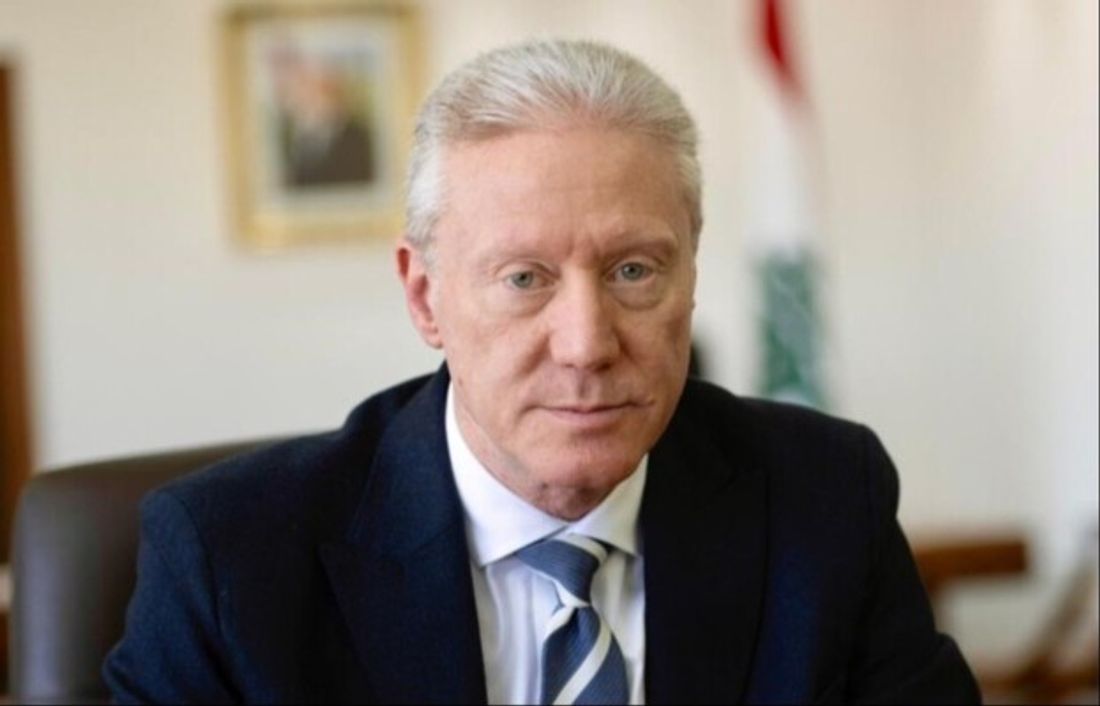
Lebanon’s Minister of Foreign Affairs and Emigrants, Youssef Raggi, affirmed in an interview with Kuwait’s Al-Rai newspaper that “Lebanon has returned to its natural position within its Arab surroundings,” adding that his visit to Kuwait aims to express Lebanon’s full solidarity with Kuwait, its leadership, government, and people, in the face of the attacks it is experiencing.
Ahead of his official visit to Kuwait, which begins on Monday, Raggi said that Kuwait “has always been a source of support and goodwill for our country, through good times and bad, and has consistently stood by Lebanon during its difficult days.”
He noted that it has been a long time since a Lebanese foreign minister last paid an official visit to Kuwait. President Joseph Aoun visited the country approximately a year and a half ago, and the current visit is intended as a follow-up.
Raggi explained that the talks will focus on strengthening bilateral relations, addressing outstanding issues, and exploring ways to encourage Kuwaitis to return to Lebanon for trade, investment, and tourism. He reassured “our Kuwaiti brothers” that Lebanon is moving in the right direction, that significant improvements have taken place at various levels, and that the government is determined to continue along this path until the end.
Raggi held the Iranian regime responsible for instability in the region, arguing that “the problem will persist as long as it does not change its behavior.” He also said that “Hezb0llah and some of its allies still control part of the deep state within the Lebanese Republic, which is obstructing progress.”
He rejected warnings of a potential civil war, saying: “When the state decides to extend its sovereignty and enforce the rule of law, and certain organizations or groups choose to confront it, we are not facing a civil war, but rather groups operating outside the law and challenging the state. The state is stronger, and nothing is stronger than legitimacy.”
He denied that there was any general threat to civil peace or any possibility of a split within the army, while not ruling out attempts to provoke strife or carry out security operations aimed at destabilizing the country.
On the issue of weapons, Raggi stressed that international support for the state and the army had not declined, while acknowledging that some parties were beginning to feel that implementation was being delayed. He said the problem lay in the time gap between decision-making and implementation.
He emphasized that “the reality in Lebanon and the region cannot tolerate any ambiguity and requires accelerating the demonstration of a genuine commitment to placing weapons under state control, in order to save the country from being dragged into another war in support of Iran.”
He added: “Lebanon is facing an unprecedented window of international support, and the train will reach its final destination sooner or later.”
Regarding the Iranian ambassador, Raggi reaffirmed his commitment to the decision declaring the previously appointed Iranian ambassador persona non grata. He stressed that the ambassador’s continued presence was categorically unacceptable and that this position was agreed upon with President Joseph Aoun and Prime Minister Nawaf Salam, with no possibility of reversing it.
He said: “Lebanon is prepared to discuss the appointment of another ambassador if Tehran puts forward a candidate. The Foreign Ministry has fulfilled its duty, while other parties were responsible for implementing his departure. As for filing a complaint or sending an official protest letter to Iran, this requires a decision at the government level.”
Commenting on remarks by Hezb0llah Secretary-General Sheikh Naim Qassem, who said that the party’s patience had limits, Raggi stated: “I want to tell Hezb0llah that it is right that patience has limits. The patience of the Lebanese state has limits, and so does the patience of the Lebanese people.” He warned against “tampering with security,” stressing that the state would stand firm against any such actions and that the people would not allow anyone to undermine their security.
Regarding the post-UNIFIL phase, Raggi explained that the Americans had informed Lebanon that UNIFIL’s mandate would not be extended in its current form, while expressing readiness to discuss an alternative arrangement.
He stressed that Lebanon does not want a security vacuum in the south, remains committed to the full implementation of UN Security Council Resolution 1701, and rejects any multinational force that could be used as a pretext against it.
He noted that a draft of a new resolution based on Resolution 1701 is being studied, although its details remain unclear.
Raggi also stressed that Lebanon rejects any direct communication between the Lebanese and Israeli armies, adding that the negotiating process is not limited to the issue of weapons control, but also includes Israel’s withdrawal, the return of prisoners, and reconstruction.