Report: "Silver Plow" is about destroying the south, not fighting Hezbollah, and paving the way for settlement under American sponsorship!
Oct 12, 2026
Israeli media reports, including Haaretz, reveal a trend within the military establishment toward a scorched-earth policy in southern Lebanon under the name "Operation Silver Plow." The paper quoted a senior officer as saying that most of what is being done now is not direct fighting with Hezb0llah but systematic destruction of buildings in southern Lebanese villages, and that the only task is to keep destroying.
According to soldiers' accounts cited by the paper, the military command drew up a map of the occupied area divided into geographic squares (polygons), assigning each field unit a square to destroy and level. The paper quoted one soldier as saying that, contrary to the army's official claims, this is not only military infrastructure: "we are destroying everything there."
According to Al-Akhbar, scrutiny shows that the Combat Engineering Corps of the enemy army forms the backbone and executor of "Silver Plow." The Yahalom unit, which specializes in dismantling tunnels, preparing large explosive charges and organizing remote demolitions, oversees the coordinated destruction of entire neighborhoods. Heavy D9 military bulldozers are also used to demolish houses, level farmland and remove civilian structures, along with civilian companies paid by the army according to a price list based on the number of houses and squares razed.
Military commanders say the army decided at some point to stop using industrial explosives because of their high cost and turned to agricultural ammonium nitrate, whose nitrogen content exceeds 36 percent, for indiscriminate destruction. Air strikes are also carried out, some sources say, as part of training programs, using outdated munitions, which explains why not all the missiles explode.
Al-Akhbar added that there is a Zionist current that openly calls for settlement in southern Lebanon. While earlier attempts to achieve this failed, groups involved in the project appear to have seen in the results of the latest war an opportunity to expand their activity. They began field reconnaissance, including infiltration of individuals into Lebanese territory. Several attempts were recorded, most notably the infiltration of a group of activists from the "Uri Tzafon" movement into the Hasbani riverbed area last July, before another group of ten Israeli women crossed the border and stayed in the Wazzani spring area. Tracking these moves shows that those behind them belong to known settler organizations, but attention is focused especially on Uri Tzafon, founded in June 2024, which held a series of online conferences discussing visions and plans to occupy parts of southern Lebanon and establish settlements there.
Notably, the movement is not far from the enemy government's leadership. Among its prominent theorists is the Zionist historian Hagai Ben-Artzi, brother of Sara Netanyahu, wife of Prime Minister Benjamin Netanyahu. He is the author of a slogan repeated by the movement's members: "We are not occupying foreign land in southern Lebanon, but completing control over land that forms the historical and natural extension of the Galilee."
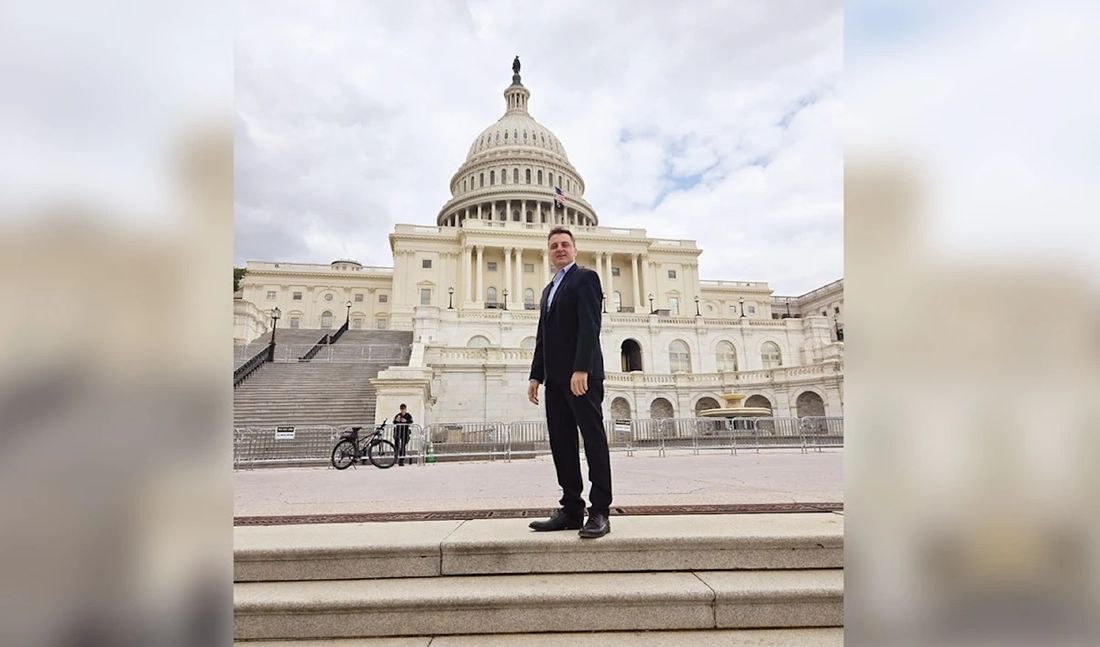
Al-Akhbar added: but Zionist projects, as at previous junctures, cannot succeed without American support and presence. In this context, a new front emerges under the title of humanitarian services, led by Bilal Maadarani, known in the United States as Bill Maadarani, a Lebanese-American whose family originates from the Zahle district. He serves as president of the American Foundation for Lebanon (AFOL) and also chairs the Overseas Security Advisory Council (OSAC), which is affiliated with the US State Department. The foundation works in Lebanon in coordination with the Lebanese army and the Red Cross.
AFOL presents itself as a body specializing in humanitarian and logistical support, and is currently active in the so-called "Christian triangle" in the Bint Jbeil district, which includes the towns of Rmeish, Ain Ebel and Debel. Its activities include securing food aid through convoys whose movement is coordinated with the Lebanese army on the side of the liberated areas, and with the occupation forces on the side of the occupied territory. The foundation claims the coordination goes through the "Mechanism" committee and that it does not communicate directly with Israeli forces. But most importantly, in securing humanitarian corridors it uses the services of a company called "Cyclops Defense," also in coordination with the Lebanese army, and it signed a memorandum of understanding with the Lebanese Diaspora Energy (LDE) association to support development projects.
According to Lebanese military sources, several meetings were held with Maadarani about ideas for work in the coming phase. He said Washington had told him of the need to cooperate with the army and security forces, and that he was seeking funding to strengthen the capabilities of Lebanese security and military forces in areas from which Israel will withdraw. He also requested facilitation for his teams, which he said are now busy with humanitarian tasks. According to the sources, Maadarani spoke of initial funding of around 200 million dollars that the American administration would provide, whether from the US government or from friendly and allied states interested in Lebanon's situation.
In practice, what is happening leads to a disturbing conclusion: the American project does not aim at liberating the land and returning people except on terms that suit Israel. The dangerous part is that American organizations like the one Maadarani leads are not concerned with essentials such as the withdrawal of occupation forces, as much as with preparing the ground for all their security and military programs. What falls under the heading of humanitarian support is, in this view, merely a facade, as with everything America does.
But the most important question is: how do these actors deal with the settlement project?

Lebanon Weather: A Fast-Moving Low-Pressure System Brings Back Rain Tuesday Night
Photos&Video: The funeral service of the late Haji Sukna Abed Ali Beydoun Saab in Dearborn
 LEBANON
 INTERNATIONAL NEWS