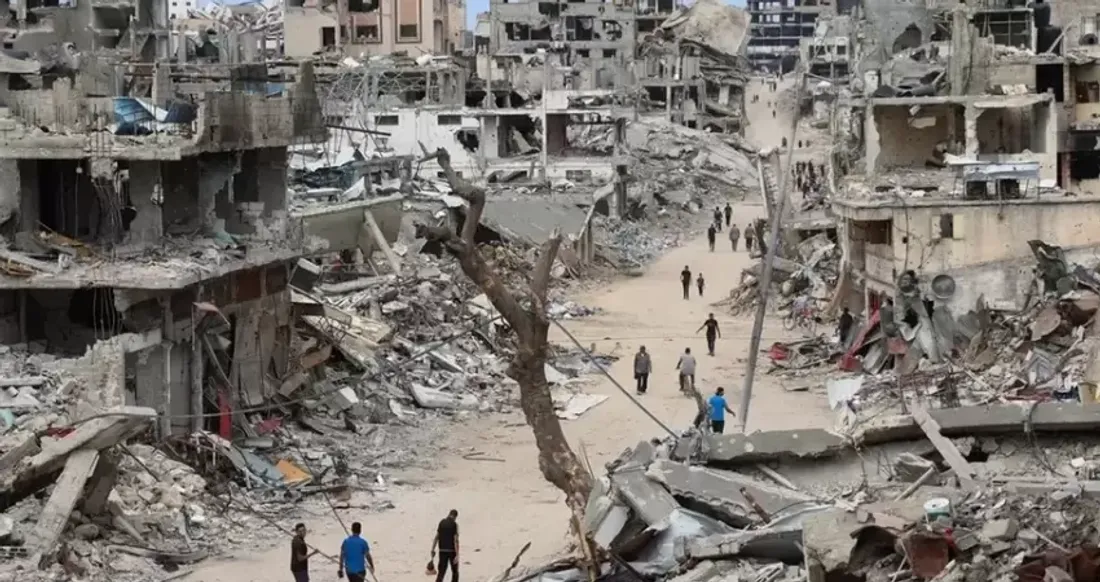
The New York Times published a report revealing the lives of Palestinians amid the aftermath of war and the rubble, debris, and destruction spread across Gaza.
The report said that the ceasefire last October nominally ended Israel's war on Gaza, which erupted after the October attacks.
The report relayed testimonies from Gaza residents describing their suffering in the wake of the war and the destruction that befell the city.
The text of the report follows:
The ceasefire last October nominally ended Israel's war on Gaza, which began after the October 7, 2023 attacks led by Hamas.
Yet a year later, Israeli strikes have not stopped, though they are less intense. More than 1,400 people in Gaza have been killed since the truce was signed, according to local health officials, while Israel maintains that it is still targeting Hamas militants.
Palestinians in Gaza are trying to rebuild their lives and restore their livelihoods, seeking to wrest some normalcy from the rubble. Some are trying to rebuild with whatever materials they can find or gather, while others are working to revive their businesses or launch new ventures.
Death and destruction have overshadowed their lives for three years, but the bombs, hunger, and displacement have not erased their aspirations for a better future.
Jaafar Atallah, 28, earned his living at his family's factory, which produces pottery and vases from the rich clay deposits near his home in the Al-Waha area of northern Gaza. Because his home was razed during the Israeli military campaign, Atallah and his family re-established their business in the town of Al-Zawayda in central Gaza.
For housing, Atallah built a modest dwelling from red bricks he made in the family's own kiln. Although they no longer have the heavy machinery needed to extract clay from the ground, they have an equally effective alternative, he says.
"We go to a crater left by an Israeli bombing, where we can reach the clay; we extract it, purify it, and then start working," Atallah says.
The dwelling consists of a single room where he now lives with his pregnant wife. The walls, made of bricks reinforced with straw, provide natural cooling during Gaza's harsh summer heat.
Atallah hopes these walls will also help retain warmth during the winter.
The United Nations says about 80% of buildings in the Gaza Strip have been destroyed or damaged by the war. Large parts of the Strip were razed during the intense Israeli assault, which killed at least 74,000 people, according to Gaza health officials. The assault came in response to the Hamas-led operation against southern Israel on October 7, 2023, in which about 1,200 people were killed and 250 hostages were taken.
Surviving homes that are still standing are limited to a lucky few Gazans, or to those with enough money to pay rent, while most of the rest live in sprawling tent camps across the Strip.
Israel restricts the entry of heavy machinery, concrete, and cement into Gaza, noting that Hamas, which still controls part of the Strip, used these materials to build a vast network of military tunnels.
Some Palestinians are trying to make use of the Strip's most abundant resource: rubble. One resourceful builder turned shattered concrete slabs into bricks to build a house.
In another case, Hassan al-Huwaihi, 34, works breaking up concrete from damaged buildings to extract the iron rods inside; the metal is straightened and used as supports for newly built or repaired structures.
"We are trying to make something new out of the rubble," al-Huwaihi says.
A Reason to Celebrate
Before the war, weddings in Gaza were lavish occasions, featuring sumptuous feasts of roasted lamb and processions winding through the streets.
Today, such pleasures have become a distant luxury for many Gazans.
One couple held their wedding at a UN school crowded with displaced people, while two other couples tied the knot on the beach with hardly any celebratory trappings.
To cover the costs of his wedding, Saeed Kafarneh, 21, worked odd jobs for several months and sold gas cylinders and aid boxes he received from relief agencies, raising about $2,000.
"We worked very hard to make it happen, but we succeeded thanks to God," Kafarneh says.
Last month, Kafarneh married Nermeen Abdel Hadi in a displacement camp in central Gaza, where his family was staying. On the day of the ceremony, Kafarneh and his relatives decorated a large tent donated by a Pakistani relief organization, hanging lights, arranging flowers, and renting a loudspeaker.
According to one Palestinian custom, the groom bathes before the wedding in a public bathhouse or at a friend's home, a ritual symbolizing the transition to married life; but here it was done differently, as friends and neighbors poured water over a smiling Kafarneh inside the tent amid cheers and dancing.
The couple held the wedding, but many friends and family members could not attend; even a short trip within Gaza can be extremely costly given the massive rise in fuel prices. Kafarneh noted that others chose not to make the trip for fear of possible Israeli attacks on the way back after dark.
"Even people who live just a few kilometers away did not come, so we celebrated with those who were around us," he said.
Returning to Earn a Living
Nevine al-Ashqar hears two constant buzzing sounds whenever she climbs to the roof of her home in the town of Jabalia in northern Gaza.
One comes from the beehives that she and her husband tend to produce and sell honey and beeswax, while the other comes from Israeli drones flying overhead, reminding them that their home lies only a few hundred yards from the front line behind which the Israeli army is entrenched.
The Trump administration's ceasefire plan envisioned a gradual Israeli withdrawal alongside the disarmament of Hamas, but neither has happened.
Before the war, in addition to one hive she kept at home, the al-Ashqar family owned about 400 beehives, most of them in the area now under Israeli military control. Al-Ashqar says nearly all of those hives were destroyed during the conflict.
At the start of the war, al-Ashqar and her family fled the fighting in Jabalia. When they returned more than a year later to try to clean their heavily damaged home, she heard a continuous buzzing.
"We went up to the roof and saw a cloud of bees coming out from among the rubble. It was an unbelievable feeling, impossible to describe," al-Ashqar says.
Al-Ashqar is the family's main breadwinner because her husband and one of her sons were injured during the war, and she has returned to beekeeping, hoping to sell the honey she produces.
"After they were injured, I became responsible for the household's affairs; it's true that my husband helps me with his expertise, but it's up to me to manage things," al-Ashqar adds.
Gaza's economy has been devastated by the war, yet a few people, like al-Ashqar, are slowly trying to bring their businesses and projects back to life.
Fishermen are heading out to sea, despite fears of trouble from the Israeli naval blockade on the Strip if they venture too far into the water. Barbers, who once owned their own shops, now practice their trade in simple, makeshift salons.
Al-Ashqar's beehives are now spread across six locations, but they produce relatively small amounts of honey. Even basic materials, such as the sugar needed to feed the bees, have become more expensive, while other materials, such as pesticides, are sometimes hard to find.
More than half of the Gaza Strip has effectively become a forbidden zone for al-Ashqar, as it is for the vast majority of the two million Palestinians living there.
Still, she says she regularly sees her bees flying away toward the Israeli-controlled area, crossing into places she can no longer visit.
"Sometimes I wish I were a bee, so I could fly away from here and go to other countries, instead of staying here trapped," al-Ashqar says.
Striving for a Better Life
Mohammed Abdel Hadi, 39, worked as a carpenter for a long time; he owned his own furniture workshop and had also worked in Turkey. His trade allowed him to join Gaza's middle class.
But the military invasion returned him to square one. Even so, Abdel Hadi affirms his determination to provide a better life for his nine children, including the youngest, Mahmoud (nine months), who was born after the war broke out.
They lack running water, so every morning he goes out with his wife, Khitam, and their children from the tent where they now live to fill large plastic containers with water from a nearby truck. They also lack electricity, so they have to pay a fee to charge their phones using a generator several hundred meters away.
Their meals often consist of simple items, such as soft white cheese and bread, provided by relief organizations. For lunch and dinner, they rely on communal kitchens that prepare large pots of staples such as rice and lentils.
Most of his children remain deprived of regular education, and Abdel Hadi sometimes worries about their future, wondering: "What fate awaits them here? Waking up, filling water containers, going to the food kitchens, and no school?"
After dark, his family finds itself forced to confront swarms of rats that infest the huge piles of garbage now accumulating in the Gaza Strip; the war has left the Hamas-run government almost completely paralyzed, making public services, such as garbage collection, extremely scarce.
Abdel Hadi tries to comfort his children; at the end of the day, he lights a fire and makes them tea.
He also plays with Mahmoud, the child who has known no homeland or home other than the tent.