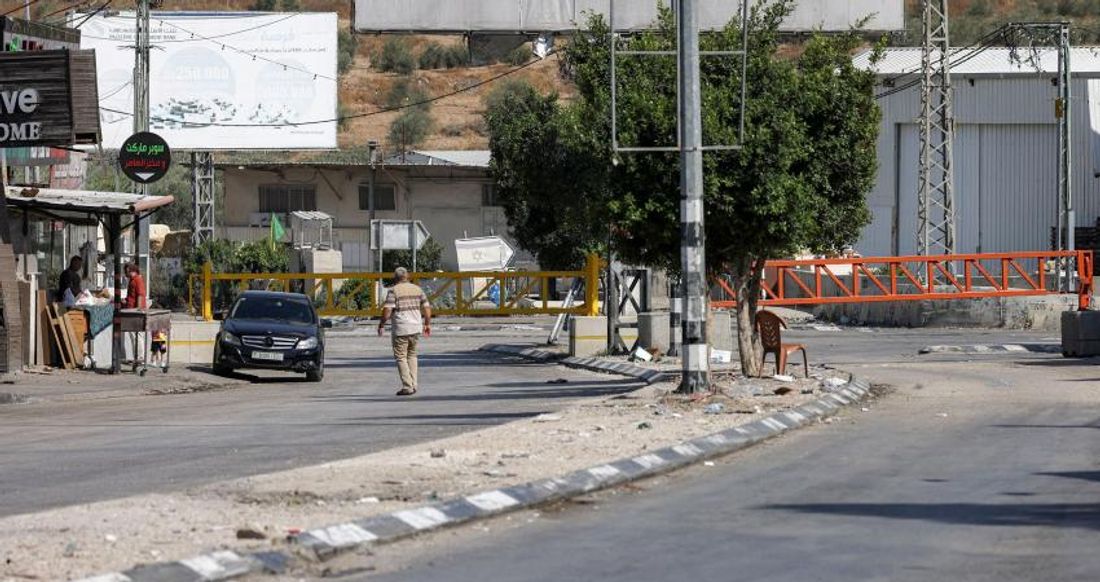
Over three years of the ongoing genocidal war on the Gaza Strip, and the escalating Israeli violations in the West Bank that accompanied it, the West Bank is going through its worst economic situation in decades, with unprecedented unemployment and tens of thousands of workers losing their livelihoods.
At the same time, the economic, productive, commercial and agricultural sectors face continuous decline under the weight of the occupation authorities' violations, rising settler violence, and shrinking sources of income for citizens, deepening the livelihood crisis that dominates daily life in the West Bank.
Workers: a bitter reality
Three years ago, Basem Yassin, a worker from the northern West Bank, lost his job inside the 1948 territories, like thousands of other Palestinian workers, when the war on Gaza began. Since then he has faced a harsh economic reality and an uncertain future.
Yassin says he struggles daily to provide food for his children, without being able to find stable work given the difficult economic conditions in the West Bank.
Since losing his job, Yassin has turned to agriculture in the Jordan Valley, but his work is intermittent and he can only work a few days here and there, because of the decline of the agricultural sector and repeated checkpoint closures that obstruct workers from reaching their workplaces.
He adds: "For three years I have barely managed, every now and then, to secure a small sum of money to buy some basic needs for my family, and providing them has become a form of daily torment."
Yassin's case reflects the reality of tens of thousands of West Bank workers who lost their jobs in the 1948 territories and struggle to find alternatives, as most economic sectors decline and occupation restrictions and violations escalate.
According to data from the Palestine General Federation of Trade Unions issued in early July, the number of unemployed people in Palestine during 1,000 days of aggression on Gaza rose to about 570,000 out of a labor force of 1.4 million, while workers' economic losses exceeded 10 billion dollars, with monthly losses estimated at about 1.35 billion shekels.
The Federation noted that 52 Palestinian workers were killed while trying to reach their workplaces or while working, and more than 38,000 arrests of Palestinian workers were recorded in the same period.
According to the Federation's data, unemployment reached 80% in the Gaza Strip and 38% in the West Bank, amid continuing economic deterioration and shrinking job opportunities.
The economy: losses beyond workers
The worsening economic losses in the West Bank are not limited to workers but extend to the commercial, service, industrial and agricultural sectors.
In this context, Abdo Idris, head of the Federation of Palestinian Chambers of Commerce, Industry and Agriculture, stresses that the economic situation in the West Bank over the last three years is the worst, noting that the loss of livelihoods for workers in the 1948 territories since the war began deprived West Bank markets of about 1.5 billion shekels per month that these workers used to inject into the local economy.
He adds that the occupation authorities' continued withholding of Palestinian tax revenues (clearance funds) for years has also cast a heavy shadow on the Palestinian economy, particularly through the salary crisis of public employees and the decline in their purchasing power. It has also piled up private-sector dues owed by the government and affected the liquidity available to institutions.
Closures of checkpoints and gates have also deepened the crisis, as the occupation authorities use them to obstruct the movement of citizens, workers and commercial transport. As a result, transport costs rose by 20%, according to Idris.
According to a field survey by the UN Office for the Coordination of Humanitarian Affairs (OCHA) in December 2025, the number of movement obstacles in the West Bank reached 925, a 43% increase over the annual average of the previous two decades.
The repercussions of the closures also affect trade with Jordan and the 1948 territories, in addition to the effect of demolitions of commercial, economic and agricultural facilities and settler attacks, which caused heavy losses, especially to the agricultural sector.
According to Idris, merchants and owners of industrial and agricultural facilities face growing financial distress and inability to meet their obligations, amid a worsening economic crisis that threatens livelihoods and deepens the fragility of the Palestinian economy.
Agriculture: the hardest-hit sector
The agricultural sector, as one of the pillars of the Palestinian economy, is among the hardest-hit sectors over the past three years, as a result of Israeli violations and settler attacks.
Commenting on this, Omar Sawafta, director of the Northern Jordan Valley Agriculture Department, points out that agriculture is a basic tributary of the West Bank economy, but it has suffered growing losses over the past three years, due to farmers' difficulty reaching their lands and getting their produce to markets, as well as the occupation authorities' seizure of land and its conversion into closed military zones or for colonial projects.
The escalating demolitions carried out by the occupation authorities, which hit large numbers of agricultural facilities, including greenhouses and wells, also worsened the sector's decline, along with land leveling and the cutting of water networks, which reduced the area under cultivation.
He noted that the Bqei'a plain, southeast of Tubas, is one of the most important examples of the scale of the occupation's targeting of the agricultural sector. Since the beginning of this year, the occupation authorities have been leveling large areas in the Atuf area and the Bqei'a plain, as part of the colonial project "the Crimson Thread," which aims to carve out a military road and build a separation wall on the lands of Tubas and the northern Jordan Valley.
In this context, data from the Atuf village council indicate that, as a result of the leveling and cutting of water lines carried out by the occupation authorities in the area, crops on 30,000 dunams of the plain dried up and were damaged, equal to a third of the plain's 96,000-dunam area.
Sawafta also stressed that the targeting of agriculture is not limited to measures by the occupation authorities but also includes the practices of settlers, who destroy crops, especially field crops. He said nearly 20,000 dunams of farmland in the northern Jordan Valley were destroyed over the past two years by settlers releasing their livestock onto them.
In addition, according to Sawafta, settlers set up pastoral colonial outposts around agricultural areas and prevent farmers from reaching and using them, as happened in the Qa'un plain belonging to the village of Bardala, where settlers established an outpost nearby about three years ago. Since then, farmers have been prevented from using and cultivating the plain.
Livestock: more than half of the herd is at risk
Regarding livestock, Sawafta explained that this sector suffered heavy losses from the escalating forced displacement of Jordan Valley communities and their encampments, due to settler violence backed by occupation forces.
According to data from the village council of al-Malih and the Bedouin encampments, the northern Jordan Valley had 20 Bedouin and herding communities, of which 8 were displaced entirely or partially as settler violence escalated.
He noted that the violations by the occupation and settlers led the northern Jordan Valley to lose more than 40% of its agricultural output over the past three years. Livestock numbers there also declined over the same period: sheep fell from about 30,000 head to 17,000, and cattle from about 2,000 to 500, meaning the loss of more than half of the area's livestock.
He explained that the northern Jordan Valley had suffered a cumulative decline in its agricultural foundations, both animal and plant, over decades due to the occupation authorities' targeting, but the last three years saw unprecedented losses, threatening a sector essential to the economy of a region considered Palestine's food basket.
Colonization and demolition: striking the foundations of the economy
Recent data from the Colonization and Wall Resistance Commission show the scale of the losses to the foundations of the Palestinian economy over the past three years, alongside colonial expansion.
According to the Commission, since October 7, 2023, the West Bank has seen 211 new colonial outposts established and the seizure of about 64,000 dunams of land.
The Commission also documented 1,814 demolition operations affecting 5,059 structures, including residential, agricultural and economic facilities, causing direct losses to property and the means of production.
In the agricultural sector, the Commission recorded attacks affecting about 147,000 trees, including nearly 100,000 olive trees, through uprooting, leveling, burning and vandalism, causing losses to farmers and harming the income sources of families that depend on agriculture.