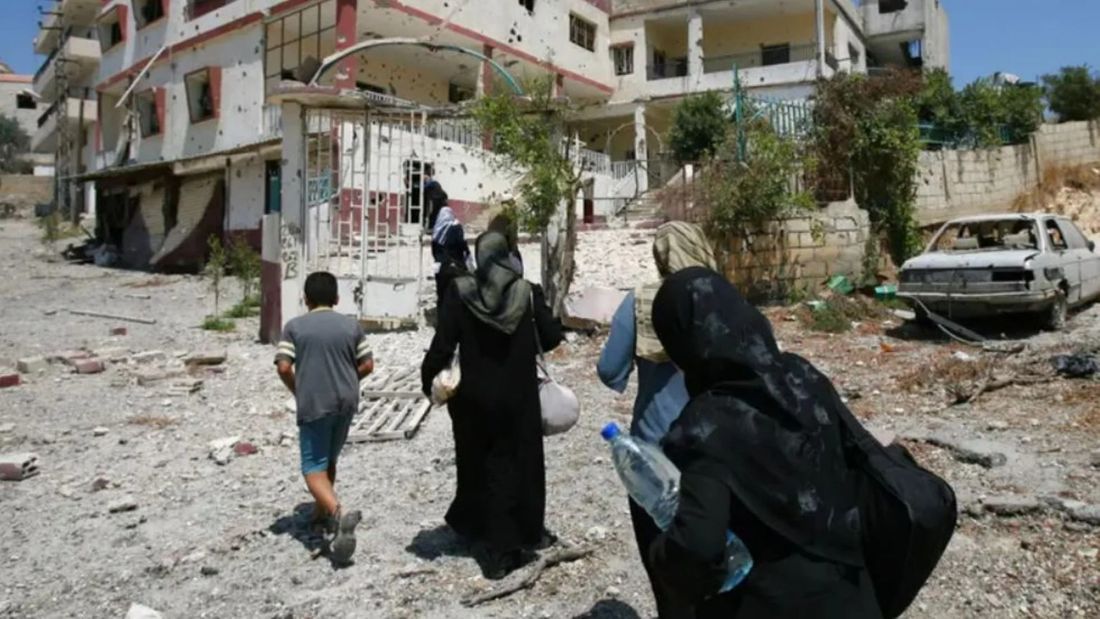
The widespread Israeli destruction of villages in southern Lebanon, along with the accompanying loss of homes and displacement of residents, has raised concerns that extend beyond the suffering of displacement itself. Villagers are increasingly anxious about the fate of their lands and real estate rights after landmarks defining property boundaries were erased, official departments were damaged, and documents were lost. While officials warn of the complexities of proving ownership in unsurveyed villages and communal (masha'a) lands following the end of the Israeli occupation, others offer reassurance that displacement and destruction do not nullify rights, noting that digitized records, neighbor testimonies, and aerial photographs can help restore them. Meanwhile, an additional challenge is emerging regarding reconstruction permits, amid fears of land sales under the weight of economic pressures.
According to a report by the National Council for Scientific Research (CNRS) covering the period between March and September 2026, more than 101,000 housing units were damaged, with destruction exceeding 75% in 43 villages. Notably, in September, the Cabinet approved a draft law banning real estate sales in areas occupied by the Israeli army.
In this context, former MP Ali Bazzi warned of the serious repercussions of systematic Israeli destruction in southern Lebanon on property ownership and the rights of owners. He pointed out that the destruction affecting homes, buildings, and facilities, alongside damage to real estate registries, has created problems concerning title deeds and proving property rights, which could lead to further complications in the future. He affirmed that the Israeli destruction was also aimed at emptying these areas of their residents and wiping them out.
Bazzi told the newspaper Asharq Al-Awsat that while some information indicates the possibility of safeguarding title deeds in certain departments, complications remain regarding Bint Jbeil and its district, which could result in future issues when proving property rights. He noted that the problem is not limited to damaged deeds and registries, but also includes the reality of ownership in several southern villages that lack green or blue title deeds, in addition to the existence of villages that have not undergone cadastral surveying.
He revealed that he discussed this issue in a meeting with Finance Minister Yassin Jaber—given that real estate registries fall under the Ministry of Finance—noting that Minister Jaber is working diligently to resolve this file and its associated complications. Bazzi stressed that the top priority is Israel’s withdrawal from the south and the Lebanese territories it has occupied, while the remaining matters can be addressed through administrative certificates (ilm wa khabar) and witness testimonies in accordance with legal procedures, taking into account exceptional cases resulting from force majeure
MP Qassem Hashem believes that the destruction of villages and ongoing displacement raise complications regarding proving residents' ownership, particularly in towns where cadastral surveys have not been completed and final title deeds are unavailable. He places these fears within the context of what he considers an Israeli attempt to empty the villages of their inhabitants and complicate their return, calling for the protection of rights and the creation of legal and administrative remedies that account for the exceptional circumstances of war.
Conversely, Qassem Hamdan, head of the Union of Jabal Amel Municipalities, affirmed that the extensive destruction inflicted upon southern villages and the continued displacement of their residents do not mean the loss of people's rights to their properties and lands. He emphasized that, in principle, there is no fear for property ownership despite the scale of destruction that has almost completely wiped out homes, buildings, and certain villages.
Hamdan explained that properties in the Jabal Amel Union of Municipalities fall into two categories: properties documented with official title deeds, and others where mechanisms for proving ownership differ. He noted that digitized real estate registries allow owners to obtain real estate statements (ifadat aqariya) proving their rights, thereby preserving the legal reference for these properties.
He added that some areas also rely on witness testimonies—particularly neighbors who know the property owners and boundaries—which helps establish rights in cases where clear title deeds are lacking. Regarding fears of losing rights, he replied: "There is no fear of losing them."
For his part, Alwan Charafeddine, Deputy Mayor of Tyre, confirmed that the widespread destruction of homes and buildings in southern villages and the loss of property documents by some residents due to the war do not necessarily mean the loss of their ownership rights. He pointed out that aerial photographs and maps documenting the locations and boundaries of buildings prior to their destruction can be utilized to address issues related to reconstruction, especially in areas lacking final title deeds.
Charafeddine explained that some southern villages contain properties whose owners do not hold green deeds definitively proving ownership, alongside state-owned (amiri) lands and others whose boundaries and landmarks were known through stone markers or existing physical features on the ground.
He added that aerial imagery captured before the destruction, including imagery available via Google Maps, shows the locations of buildings, their boundaries, and the landmarks that stood there, which can be relied upon to determine the sites of destroyed structures. However, he pointed out that "the most complex issue relates to buildings constructed on communal (masha'a) lands, where municipalities face legal difficulties in granting renovation or reconstruction permits."
He said: "We have a problem regarding communal lands, even when it comes to renovation; as a municipality, we cannot grant the necessary permits for renovation or construction without a legal remedy from the state. We are awaiting a special legal opinion and an exceptional decision from the State Shura Council that can be relied upon to resolve the status of buildings standing on these lands."