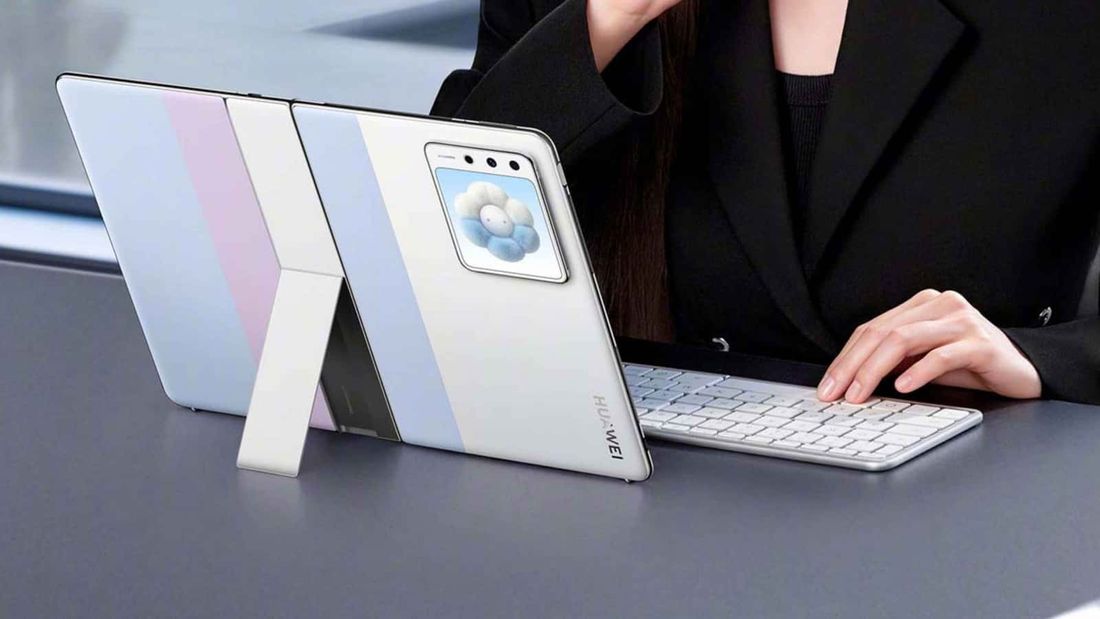
In an unusual design move for laptops, Huawei has unveiled its new MateBook Fold S, combining a foldable display with a feature inspired by smartphones: a square external screen built into the back of the device’s lid. It allows users to check notifications and run certain applications without having to fully open the laptop.
The external screen, called Live, measures 3.5 inches and resembles the cover displays found on foldable phones. It provides quick access to certain functions and information while the device is closed, eliminating the need to open the main screen every time.
A Flexible, Ultra-Lightweight Display
The internal display uses flexible OLED technology and measures 14.7 inches when the laptop is fully unfolded, shrinking to 10.2 inches when folded. This makes the device more like a compact computer that is easy to carry around.
The specifications highlight Huawei’s focus on reducing weight and size. The device weighs approximately 639 grams in black and white, rising to 647 grams in the blue version. It measures 6.49 mm thick when unfolded and 12.98 mm when folded.
The MateBook Fold S is powered by a Kirin XE90 processor, with RAM options ranging from 16GB to 32GB and storage capacity of up to 1TB. It runs HarmonyOS 7, Huawei’s operating system designed for computers, instead of Windows.
The innovations are not limited to the external display. Huawei has also equipped the device with a 50-megapixel rear camera, a 12-megapixel front camera and a 46Wh battery that supports 66W fast charging.
The Future of Foldable Computers
According to published information about the device, its price in China starts at 14,999 yuan and reaches 22,999 yuan for the top-tier version, which comes with 32GB of RAM and 1TB of storage. Huawei has not yet announced when it will be available in international markets.
The MateBook Fold S reflects Huawei’s attempt to rethink laptop design by bringing the external-screen concept popularised by foldable smartphones to computers, offering quick-access functions without requiring users to open the main display.